


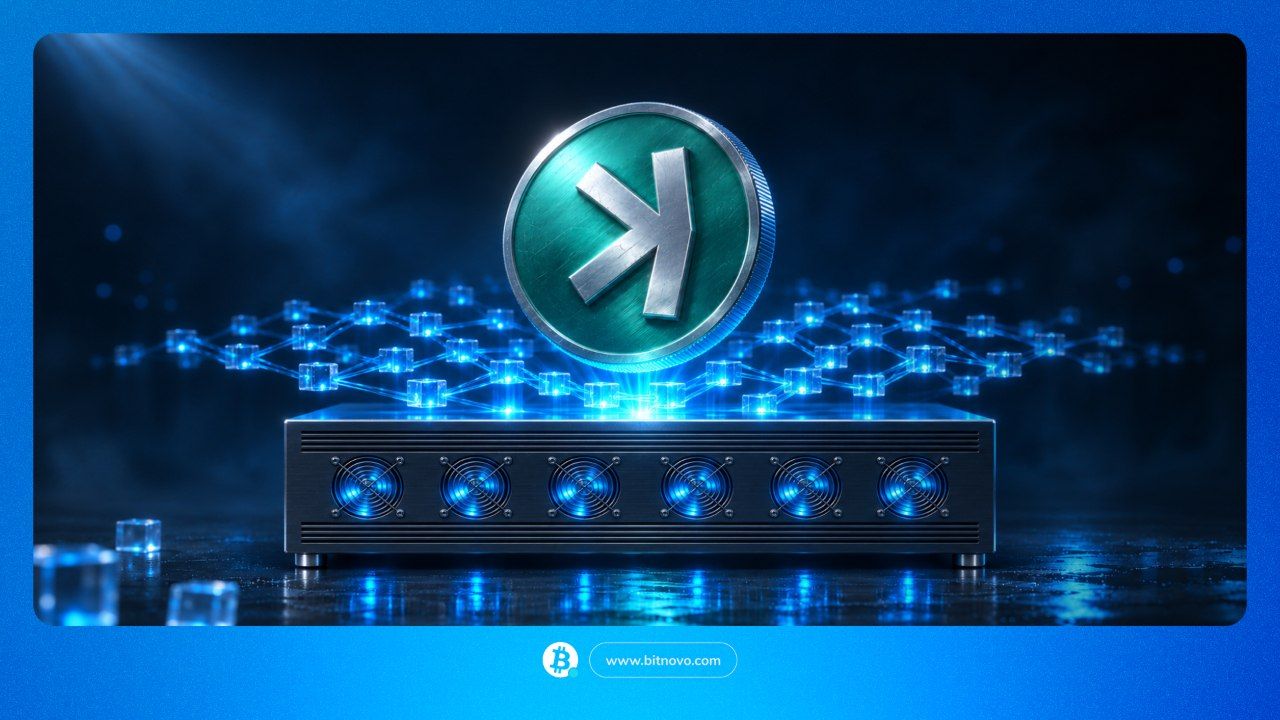
Kaspa is one of the few new networks that still use proof of work (PoW), and it does so by generating 10 blocks per second. This immediately raises the questions every reader asks: what exactly is this network, why is it so different from other blockchains and does it really make sense to mine it today?

What Kaspa is
Designed by the Israeli computer scientist Yonatan Sompolinsky and officially launched on November 7, 2021, Kaspa is a decentralized Layer 1 network and open source. It differs radically from the rest by using BlockDAG technology (Directed Acyclic Graph by blocks) instead of the traditional linear chain structure of blocks.
|
Feature |
Detail |
| Currency symbol | KAS |
| Maximum supply | ~28.7 billion KAS |
| Consensus mechanism | Proof of Work (PoW) Nakamoto style |
| Launch | Fair Launch (No premining, ICO or private allocations) |
Unlike other projects, Kaspa was designed under a fair launch scheme inspired by the original philosophy of Bitcoin: there was no prior mining by the developers, no token pre-sales and no corporate reserves.
Advantages of Kaspa
Beyond being a community-driven project free of prior allocations, the true appeal of Kaspa lies in its engineering design. By combining Bitcoin’s security model with a directed graph structure, the network solves several of the historical bottlenecks of crypto mining and infrastructure.
|
Advantage |
Description |
| Extreme speed | It generates 10 blocks per second on its mainnet, allowing near-instant transaction confirmations in a matter of seconds. |
| Real scalability | Its BlockDAG architecture allows it to process multiple blocks in parallel and thousands of transactions per second without generating congestion on the network or driving up commission fees. |

What is a BlockDAG and how does it work in Kaspa?
Unlike Bitcoin, which uses a linear blockchain where parallel blocks are discarded, Kaspa operates on a Directed Acyclic Graph (BlockDAG). This structure does not waste blocks: it integrates them all into an interwoven framework that strengthens as it grows.
Simply put: It is like a multi-lane highway instead of a single narrow lane. Multiple blocks advance in parallel and the system takes care of ordering them without stopping traffic.
The consensus engine: GHOSTDAG
Based on the PHANTOM research (Sompolinsky and Zohar), the GHOSTDAG protocol is responsible for organizing this parallel flow:
- Blue vs. Red blocks: It classifies blocks according to their propagation time. The blue ones are the valid ones produced in parallel within the normal range, the red ones fall outside the accepted margin.
• Blue Work: To resolve conflicts (such as double spending of coins), the protocol selects the route with the greatest accumulated work (blue work) and establishes a definitive chronological order.
The future: DAGKnight
Currently the mainnet works with GHOSTDAG, but the project has DAGKnight in development, an evolutionary protocol that will not depend on a fixed value, but will adapt dynamically to the real latency of the network.

Why is Kaspa so fast?
Kaspa’s speed is not due to centralization or sacrificing security, but to its computational architecture. While Bitcoin must wait about 10 minutes between blocks to avoid collisions and forks in a linear chain, Kaspa’s BlockDAG model processes and validates blocks in parallel continuously.
The Crescendo upgrade: The leap to 10 blocks per second
On May 5, 2025, Kaspa marked a historic milestone in Proof-of-Work networks by activating its Crescendo upgrade. With this hard fork, Kaspa’s mainnet increased its emission speed from 1 to 10 blocks per second (10 BPS), reducing the generation time of each block to just 100 milliseconds.
What does this change imply for transaction confirmations?
- Instant visual confirmations: By generating 10 blocks every second, a transaction sent to the network appears registered and included in the DAG almost instantly (in a few milliseconds).
• Irreversible finality in seconds: In Bitcoin, obtaining 6 confirmations requires about an hour. In Kaspa, getting dozens of block confirmations to ensure that a transaction is mathematically irreversible takes just a couple of seconds.
• Payment experience: This processing rate allows transactions at points of sale and everyday digital payments with the same fluidity and immediate response as a credit card, but preserving the security and decentralization of a Proof-of-Work system.
How Kaspa is mined
- Choose specialized hardware: Graphics cards (GPU) became obsolete for this network due to the increase in global hashrate. Today specific ASIC equipment is used.
- Set up your own wallet: It is essential to have a secure Kaspa address to directly receive the rewards generated by the equipment.
- Join a mining pool: Connecting the ASIC equipment to a consolidated mining group (pool) allows receiving constant and proportional payments according to the hashrate contributed.
- Calculate consumption and electricity cost: Due to the current difficulty of the network, profitability depends closely on accessing competitive electricity rates and evaluating the performance of the rig using specialized ASIC mining calculation tools.

What to assess before mining
Entering Kaspa mining should not be seen as an automatic or guaranteed benefit, it is an industrial and computational activity subject to multiple operational and market variables. Before making any investment in specialized hardware (ASIC) or assuming energy consumption commitments, it is essential to carry out a rigorous financial evaluation considering the following key factors:
|
Variable |
Key aspect |
Financial impact |
| Electricity cost | High and continuous consumption. | High rates can exceed the value of the mined coins. |
| Network difficulty | Global hashrate constantly increases. | The higher the difficulty, the fewer KAS the equipment extracts. |
| Chromatic emission | Gradual reduction of the reward month by month. | You will receive progressively fewer coins each month. |
| KAS price | Price subject to market volatility. | A price drop delays the recovery of the investment. |
| ASIC obsolescence | Rapid evolution towards more efficient models. | Risk of equipment depreciation before achieving ROI. |
Kaspa has demonstrated that Proof of Work can still evolve towards unsuspected levels of speed and efficiency. Its combination of academic innovation and commitment to decentralization positions it as one of the most fascinating technological experiments in the history of distributed ledgers.
FAQ
- What is Kaspa (KAS)? It is a Layer 1 cryptocurrency based on BlockDAG technology to process ultra-fast transactions.
- Does Kaspa use proof of work or proof of stake? It uses Proof of Work (PoW).
- Can Kaspa be mined with a graphics card? It is not profitable, it requires specialized ASIC equipment.
- What is a BlockDAG? It is a structure that processes multiple blocks in parallel instead of a single linear chain.