



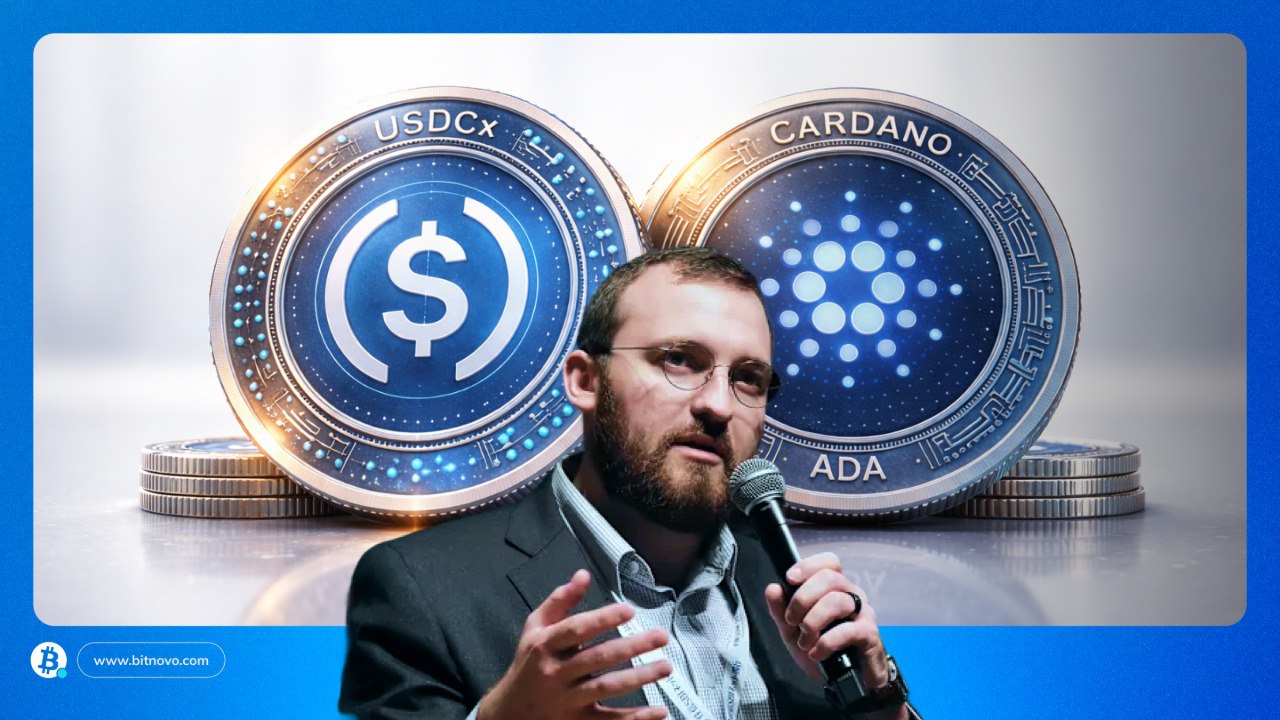
The founder of Cardano, Charles Hoskinson has confirmed an integration agreement to bring USDCx to the Cardano ecosystem, following an agreement signed between Circle and the Pentad group (comprised of IOHK, EMURGO, Cardano Foundation, Midnight Foundation and Intersect). The objective is clear: inject stable liquidity «in dollars» to boost the DeFi sector.
It is vital to clarify that we are not talking about a «native» USDC, issued directly by Circle on Cardano, but rather USDCx, whose real utility will depend on how quickly it is adopted by wallets, exchanges and dApps after its deployment.
Hoskinson announced the deal from Japan, stating that he had finalized the integration agreement for USDCx on the network. According to Charles Hoskinson, this collaboration welcomes Circle into the ecosystem with new possibilities ahead. «Hello from Japan. I just signed the integration agreement for USDCx on Cardano. Welcome to Cardano Circle! We are all excited about the possibilities.»
In turn, he said that the agreement is signed and positioned the integration as short-term rather than aspirational. «This is not something that is six months away, the ink is on the paper, the deal is signed.» Adding that the integration work should occur «in short order.»
What is USDCx and how does the xReserve model work?
Cardano has taken a confident step in its critical infrastructure with the announcement of the integration of USDCx, a strategic agreement between Circle and the Cardano Pentad group. Unlike native USDC, USDCx is a version designed specifically for non-EVM ecosystems, allowing the network to access Circle’s massive liquidity without the vulnerabilities of third-party bridges.
For this integration to be successful, it relies on two pillars:
- Circle’s xReserve Model:It is the trust engine. It works through a Circle smart contract (generally on Ethereum) where real USDC is locked to back 1:1 each USDCx issued on Cardano. The system uses programmatic attestations, eliminating the security risks associated with traditional «wrapped» assets.
- UTXO and Plutus Optimization:Cardano’s infrastructure allows USDCx to move with the efficiency of native assets, preparing the ground for a fluid user experience where the exchange between USDC and USDCx is almost invisible to the investor.
Now, although the Cardano ecosystem is advancing in privacy through projects like Midnight (which uses zk-SNARKs), the main value of USDCx on the Cardano mainnet is the certainty of backing and the liquidity depth for the DeFi sector.
As Charles Hoskinson rightly pointed out when confirming the agreement: «The goal is that you can move from USDC and vice versa without additional steps.» This is not a future promise; it is a signed contract that seeks to provide Cardano with a «dollar» with an institutional standard.
|
Feature |
Native USDC |
USDCx (xReserve Model) |
| Issuance | Issued directly by Circle on the network (e.g., Ethereum, Solana). | Issued on a «partner» chain (Cardano) with backing on a «source» chain. |
| Backing | Reserves of cash and United States Treasury bonds. | Backed 1:1 by native USDC locked in Circle’s xReserve contract. |
| Security | Direct issuer risk (Circle). | Eliminates «third-party bridge» risk through Circle’s automated attestations. |
| Architecture | Designed mainly for EVM environments (Ethereum). | Optimized for non-EVM networks (such as Cardano’s eUTXO model). |
| Availability | Limited to networks with direct Circle integration. | Allows expanding Circle’s liquidity to Cardano quickly and securely. |
The impact on DeFi: Liquidity, efficiency, and lending
The arrival of USDCx is not just a technical improvement, it is the removal of the «growth ceiling» that held back DeFi applications on Cardano. As Hoskinson notes, without a solid stablecoin base, markets are more expensive and less deep, USDCx arrives to change this dynamic through three key axes:
- Access to the «Circle Network»:The agreement not only brings a token, but connects Cardano with all of Circle’s global infrastructure and liquidity. This allows lending protocols and treasuries to operate with an asset of institutional trust.
- The «Mirror Effect» for Non-EVM Chains:Being an asset designed for ecosystems outside the Ethereum Virtual Machine (EVM), it allows networks like Cardano to connect to dollar liquidity without complex integrations. This enables developers to build multiple financial products on a stable and recognized value base.
- Fluid user experience:The ultimate goal is technical invisibility. According to Hoskinson, the key to success will be total integration into dApps and exchanges so that the user can convert USDC to USDCx (and vice versa) without friction, additional steps, or complicated processes.

The future of USDCx in Cardano
|
Dimension |
Current reality (Announcement and model) |
Success factors (Execution and adoption) |
| DeFi Liquidity | Signed agreement to connect with Circle’s global liquidity network. | Market depth: Real volume in liquidity pools and lending protocols. |
| Infrastructure | xReserve model defined with 1:1 backing to avoid third-party bridges. | Technical support: Native integration in wallets (e.g., Lace, Eternl) and exchange listings. |
| Interoperability | Solution optimized for non-EVM architectures (Cardano, Aleo, Stacks). | dApp adoption: Number of protocols that use USDCx as their reference «dollar». |
| Business vision | Focus on enterprise adoption and regulatory compliance. | Privacy and scalability: Innovation in dApps that use Cardano’s privacy for institutional use. |
As Steve Jobs rightly said: «Technology is nothing. What’s important is that you have faith in people, that they’re basically good and smart, and if you give them tools, they’ll do wonderful things with them.»
With USDCx, Cardano delivers one of the most anticipated tools for its community, now begins the stage of seeing what wonders the ecosystem will build upon it.