




Cardano was not born from an Internet meme or an improvised whitepaper to raise money quickly. In 2015, Charles Hoskinson proposed something that seems crazy in this space: that every technical decision must first pass through the filter of academic review.
While the rest of the crypto ecosystem runs blindly under the motto of «move fast and break things», Cardano decided that to build the future of money, you cannot play with trial and error.
What is Cardano and where does it come from
In 2014, Charles Hoskinson, co-founder of Ethereum, left the project after a brutal ideological clash with Vitalik Buterin. While Vitalik wanted a non-profit foundation, Hoskinson demanded a commercial structure and millimeter-precise development. The result of that fight was the founding of Cardano in 2015 and its launch in 2017.
That is why, in clear terms, Cardano was designed as a third-generation open-source network to execute smart contracts and dApps. But with a key difference: it was built from day one under a Proof of Stake (PoS) model.
And where does the name come from? It is a direct tribute to Gerolamo Cardano, a 16th-century Italian polymath and mathematician who revolutionized equations and laid the foundations of probability. Naming the network after him was Hoskinson’s first declaration of intent: in a market governed by wild speculation, this project decided to entrust its destiny to exact mathematics.
Charles Hoskinson and the origin of the project
Charles Hoskinson did not come to Cardano by chance. As a co-founder of Ethereum, Hoskinson saw first-hand the vices of the ecosystem. In 2015, tensions with Vitalik Buterin exploded: Buterin insisted on keeping Ethereum as a non-profit organization, while Hoskinson demanded a commercial, ambitious, market-oriented structure.
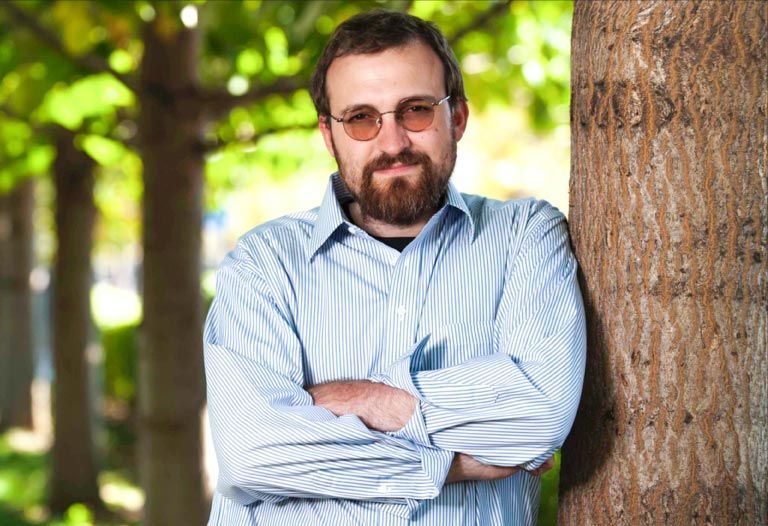
After that ideological blow, Hoskinson allied with Jeremy Wood to found IOHK (Input Output Hong Kong) with a single objective: to bring Cardano to life and show the world how a real blockchain is built.
What is ADA?
ADA is the platform’s native token and, just like the network’s name, its identity is a tribute to the history of science. It is named in honor of Ada Lovelace (1815-1852), a British mathematician and daughter of the poet Lord Byron.
As a cryptocurrency, ADA is not a simple digital asset, it is a multi-functional tool designed to give real power to its users through three pillars:
- Secure value exchange:You can send and receive ADA anywhere in the world quickly and transparently.
- Network participation (Staking):Every ADA holder has a direct stake in Cardano’s security.
- Real governance:ADA holders have a voice and vote in the protocol.
How Cardano works: two layers and a peer-reviewed protocol
Cardano’s architecture is not a solid, inflexible block; it is separated into two independent layers with very well-defined functions. This structure allows one part of the system to be updated without putting the other at risk.

- The Settlement Layer (CSL: Cardano Settlement Layer). It is exclusively responsible for moving, recording and securing the ADA token. This layer guarantees that value transactions are always ultra-fast, secure and with minimal costs.
- The Computation Layer (CCL: Cardano Computation Layer). It is the space designed to host smart contracts and decentralized applications (dApps). Developers have flexibility to create, modify and improve applications without saturating the network’s financial traffic.
Ouroboros: the consensus protocol that went through university
The true engine of Cardano is a unique piece of engineering called Ouroboros. Its name comes from the Greek symbol of the serpent devouring itself, representing eternal cycles and infinite regeneration. Hoskinson named it that because the protocol is designed to be self-sustaining, grow and scale perpetually.
Ouroboros is the world’s first mathematically verified and peer-reviewed Proof of Stake (PoS) mechanism, developed in collaboration with institutions such as the University of Edinburgh. Ouroboros devastates the competition by consuming a minimal fraction of energy, applying cryptography and game theory to sustainably shield the network.
Instead of miners with expensive computers, the network is kept secure and decentralized thanks to Stake Pools:
- Selection:The protocol divides time into cycles called epochs and slots. Randomly and automatically, Ouroboros chooses a validating node (stake pool) to create the next block of transactions.
- Weight of the vote: The more ADA coins backing that pool, the greater its mathematical chances of being chosen to validate.
- Lock-free security: Users can delegate the weight of their coins to a node to support their trust in it, helping to secure the network in a distributed manner, without the funds ever leaving their wallets or being frozen.
The five stages of Cardano’s development
Unlike other projects, Cardano designed its destiny from day one. Its evolution is divided into five eras named after great figures of literature and science. It is a coldly calculated roadmap to transform an experimental network into a decentralized global empire.
|
Era |
Launch | Main Focus |
Key Achievement |
| Byron | September 2017 | Foundation | Mainnet launch, ADA token and Daedalus wallet. |
| Shelley | July 2020 | Decentralization | Node control for the community and start of delegated staking. |
| Goguen | September 2021 | Smart Contracts | Activation of Alonzo upgrade (DeFi, dApps and NFT). |
| Basho | 2022 – 2023 | Scalability | More speed with side chains and the Layer 2 Hydra solution. |
| Voltaire | 2024 onwards | Governance | Voting system and treasury for a 100% self-sustaining network. |
Who is behind Cardano
Cardano operates as a high-level corporate and institutional machine. To prevent power from concentrating in one place, the ecosystem is governed by three independent organizations with distributed roles:
- IOG (Input Output Global, formerly known as IOHK). Its sole job is to design the network architecture, write the code under strict scientific standards, and ensure that Cardano’s mathematical engine works without a single flaw.
- The Cardano Foundation. It is an independent non-profit entity responsible for overseeing the ecosystem, protecting the brand and educating the public. Its main mission is to promote global adoption of the network and build bridges with governments and large international financial institutions.
- EMURGO. This organization is the commercial arm of the ecosystem and is responsible for ensuring that Cardano’s technology has a real impact on traditional businesses. Its task is to forge strategic alliances, finance emerging projects and develop practical applications for the corporate sector.
Cardano and energy sustainability
Thanks to its Ouroboros protocol, the network operates on a minimal fraction of the electricity consumed by Proof of Work-based systems.
This advantage is not just an ecological argument; it is a technical and legal shield. In a compliance report prepared by the Cardano Foundation and the Crypto Carbon Ratings Institute (CCRI), it was demonstrated that the network’s electricity consumption indicators, carbon footprint and marginal energy demand are light-years ahead of its competitors.
This is not a minor detail: it proactively aligns the blockchain with the environmental requirements of the MiCA regulation, positioning the project as one of the best prepared for the institutional legal framework.

To tangibly offset its historical footprint, the Cardano Foundation partnered with the environmental restoration platform Veritree. The stated and transparent goal of this alliance is to plant more than one million trees, using the blockchain itself to record, verify and immutably track each planted tree.
How to buy and store ADA
If you have decided to take the step and interact with the Cardano ecosystem, the process is purely practical, but it requires making a couple of smart decisions. It is not about buying recklessly; your obligation is to review the available platforms, compare network fees and ensure wallet compatibility so you don’t get unpleasant surprises.
For those operating from the European market, one option is Bitnovo Wallet, a platform aimed at simplifying the process by eliminating unnecessary technicalities. When operating from the Eurozone, monitoring the Ada euro pair closely is key to executing your orders at the right time and avoiding losses from hidden fees or currency conversions.

However, Cardano has a wallet ecosystem tailored to your needs:
- Daedalus:Downloads a complete copy of the Cardano blockchain to your computer to validate each transaction directly.
- Yoroi: If you are looking for speed and convenience for everyday use, Yoroi is a lightweight wallet that works as a browser extension or mobile app.
What real uses does Cardano have
Cardano’s infrastructure already performs concrete functions in the real world. However, to understand where the project stands, you have to separate what already works at full capacity from what is still maturing.
- Native assets and NFTs:Anyone can issue native assets or NFTs directly on the network quickly and with the same mathematical security as ADA itself.
- Decentralized Applications (dApps) and DeFi: The financial ecosystem is already an operational reality, although its liquidity volume remains lower compared to its direct competitors.
- Active governance: With the arrival of the Voltaire era, the most real and tangible use today is voting power. Users use their funds to propose, vote and decide the destination of community treasury funds.
If you decide to interact with this network, you must do so at your own risk and with full awareness of the extreme volatility of ADA’s price, technical development that is still ongoing, and fierce competition from other layer-1 platforms. This does not constitute investment advice or a promise of profitability, but an invitation to educate yourself and always operate with absolute caution. The steps are not forthcoming, they are urgent!