



Ethereum prepares Hegota: The biggest upgrade since The Merge arrives in late 2026
Last updated:
The Ethereum ecosystem is preparing for its most ambitious upgrade cycle since The Merge. The core developers have confirmed a more agile semi-annual schedule to respond to community demands, positioning Glamsterdam (first half of 2026) and Hegota (late 2026) as the pillars toward the so-called “Ethereum 3.0.”
The goal is clear: transform transaction processing, improve network state management, and scale the protocol to support global institutional demand, reaching tens of thousands of transactions per second without losing decentralization.
In short, the arrival of Hegota in late 2026 promises to mark a historic turning point in Ethereum evolution and technological maturity.

What Is Hegota and Where Does the Name Come From
Hegota is the code name for Ethereum’s major upgrade, scheduled for the third or fourth quarter of 2026. True to the Ethereum Foundation’s tradition, the term is an acronym that merges the two engines of the network:
- “Bogotá” (Execution Layer):Honoring the host city of Devcon, where smart contracts and transactions are processed.
- “Heze” (Consensus Layer):Following the astronomical convention of using star names for the layer where validators reach agreement.
Although the final list of Ethereum Improvement Proposals (EIPs) will be refined in Core Devs meetings, the technical focus of this hard fork is already very clear.
While its predecessor, Glamsterdam, will focus on immediate performance and the MEV (Maximal Extractable Value) structure, Hegota will arrive to solve long-term structural challenges: network state overload, excessive storage on nodes, and censorship resistance.

Verkle Trees: Less Storage, More Decentralization
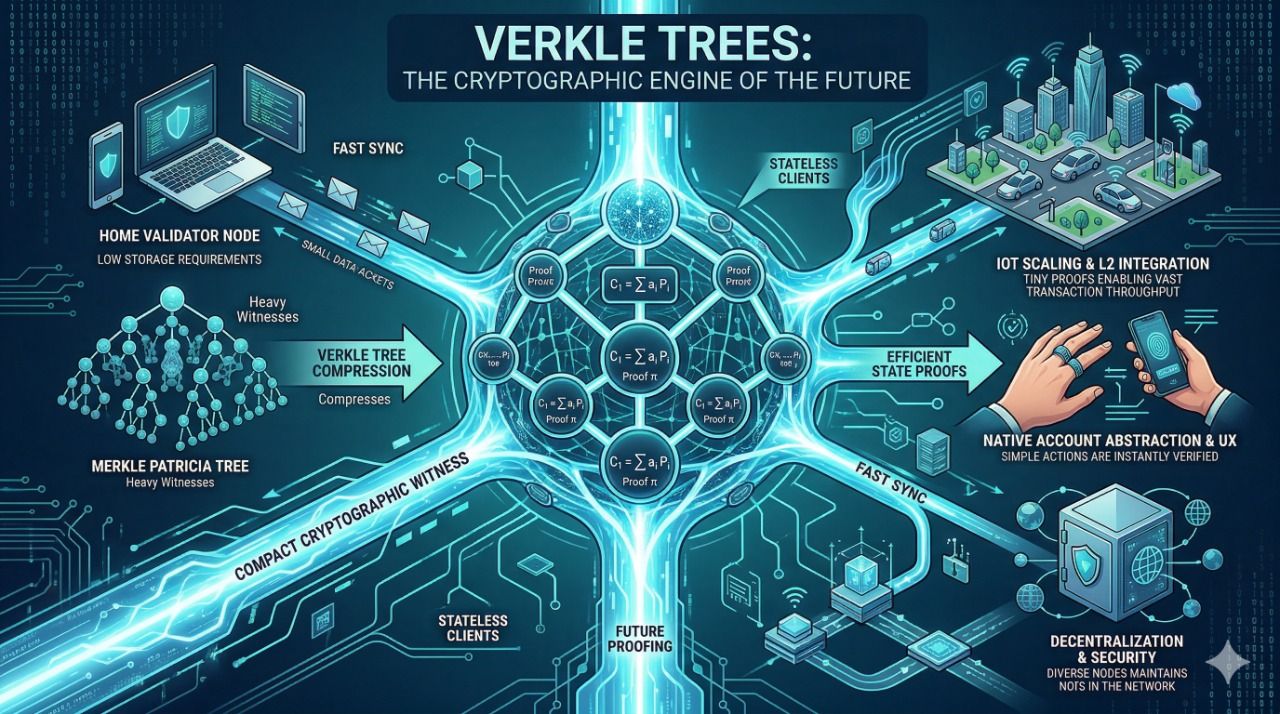
The deepest technical change in Hegota is the replacement of the old Merkle Patricia Trees with Verkle Trees as the official data structure for storing the network state (balances, contracts, and accounts). It is, without a doubt, the central element of this hard fork and one of the biggest promises on Ethereum’s roadmap since 2020.
What does this mean in plain language? Currently, for the network to function, Ethereum nodes need to store a complete copy of absolutely all the blockchain’s state (balances, contracts, and accounts). This requires increasingly expensive hard drives and hardware, which pushes out regular users and centralizes the network. Verkle Trees solve this problem at its root by allowing much more compact state proofs. It is estimated that this mathematical change could reduce node storage requirements by around 90%.
By making the network so lightweight, this upgrade opens the door to stateless clients. Thus, anyone will be able to sync and validate the network in minutes from common hardware, returning Ethereum to its truly decentralized essence.
Stateless Clients: Nodes Without Large Hard Drives
With Verkle Trees, a node does not need to store the entire network state to verify transactions. It only needs to verify proofs. This makes stateless clients possible: nodes that can run on devices with much less storage, potentially including mobile phones. The direct effect is that more people could operate a node without needing specialized hardware, which reinforces network decentralization.
Indeed, Hegota completely changes the landscape. By attaching compact proofs to each block, a receiving node can verify its validity using only those proofs, without needing the full database on its hard drive.
FOCIL: The Proposal That Forces Transaction Inclusion
If Verkle Trees solve storage, Fork-Choice Enforced Inclusion Lists (FOCIL, EIP-7805) solve censorship. This confirmed feature of Hegota aims to shield network neutrality directly from the protocol.

By the way, the debate over censorship on Ethereum grew after sanctions on Tornado Cash, when several centralized block builders began filtering transactions. FOCIL changes this through a structural mechanism:
- Random selection:The protocol randomly selects multiple validators to act as transaction “includers” in each block.
- Mandatory inclusion:If a builder tries to exclude a valid transaction that an includer has marked, the network rejects the entire block.
This randomness makes it structurally difficult for any actor or government to block a specific transaction.
Account Abstraction: The Most Anticipated Change by Users
Alongside censorship resistance, usability is the other great pillar of the network’s future. In March 2026, Vitalik Buterin announced that Hegota would include native account abstraction via EIP-8141.
There is also an important synergy between FOCIL and AA (EIP-8141, which is based on 7701):
8141 makes not just smart accounts (including multisig, quantum-resistant signatures, key changes, gas sponsorship) first-class citizens, it also can do the same for privacy protocols… https://t.co/wLCEuq66eI
— vitalik.eth (@VitalikButerin) February 19, 2026
In reality, the goal is to turn wallets into first-class programmable smart contracts. This would allow your wallet to natively initiate transactions without needing a separate external account to pay fees.
If implemented, it would completely change the common user experience with features like:
- Goodbye to mandatory ETH:It would allow gas sponsorship. DeFi apps or games could absorb fee costs as an acquisition strategy, allowing new users to operate without having ETH in their wallet.
- Advanced security:Native support for multi-signature authorization, automatic key rotation, and account recovery systems.
- Future-proofing:Direct compatibility with quantum-resistant signatures.
However, although Buterin described it as a historic improvement aligned with cypherpunk principles, the Ethereum Foundation downgraded this feature to secondary in April 2026 due to a lack of consensus on implementation details. Therefore, its final inclusion in Hegota is not yet confirmed.
Where Hegota Stands on Ethereum’s Roadmap
The Ethereum Foundation organizes its 2026 development strategy around three main axes: scaling, user experience improvement, and protocol robustness.
Under this structure, the two major upgrades of the year divide the work sequentially:
- Glamsterdam (First half of 2026):This is the first step of the year and focuses on processing speed and parallel execution, preparing the ground for the network to process more information in less time.
- Hegota (Second half of 2026):Takes the baton right where the previous one leaves off. Its focus shifts entirely to data storage and ensuring long-term decentralization, ensuring the network remains lightweight and accessible.
Core developers aim to implement Hegota tentatively during the fourth quarter of 2026, following Glamsterdam’s deployment. However, the final date will depend on the success of testnets and the complex data migration passing all security audits, so the schedule could shift to early 2027 if any unforeseen issues arise in the first phase.
What It Means for Those Who Hold or Use ETH
For the user who does not want to get bogged down in technicalities, Hegota’s deployment translates into very practical day-to-day improvements:
- Much simpler wallets:If account abstraction is finally confirmed, managing your wallets will be significantly simplified, allowing functions such as more flexible fee payment or more intuitive key recovery.
- Greater accessibility:The birth of stateless clients could allow verifying transactions directly from much more accessible and everyday devices, without forcing you to buy specialized hardware.
- Freedom and neutrality:FOCIL’s implementation makes the network much more resistant to external interference or blocks, ensuring your operations are processed without censorship.
To conclude, it is essential to be clear that none of these structural improvements directly affect ETH’s price nor guarantee any profitability. This is an evolution in the network’s usability, security, and efficiency, so there are no price predictions associated with this change.