



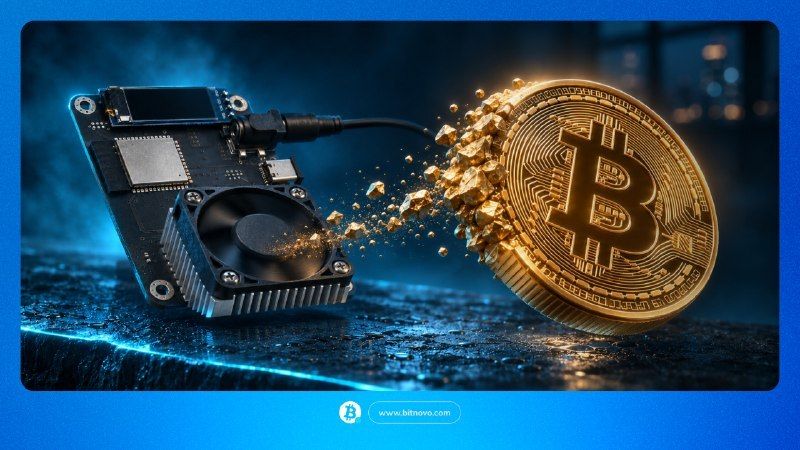
A Bitcoin miner the size of a hand that consumes less than a traditional incandescent bulb, as is the case with Bitaxe, has caught the attention of those seeking to understand how the network works from home.
However, beyond the enthusiasm for technology and practical learning, the real doubt of any user arises: what can objectively be expected from equipment of these dimensions in terms of performance and profitability.
What Bitaxe Is and How It Works
Bitaxe is a small, open-source Bitcoin miner powered by one or two ASIC chips (the same integrated circuits found in Bitmain’s powerful Antminer equipment). It works connected directly to your Wi-Fi network and stands out for its compact size, similar to that of a human hand.
However, it is important to understand the balance between what is open and what is not:
- What is open: Its hardware design and control software based on free firmware are fully open source. Anyone can manufacture, modify, or audit its circuitry.
- What is not: The main component, the mining ASIC chip, is of proprietary architecture and manufactured by third parties. It is not open source.
How Much It Consumes and What It Yields
Taking the Bitaxe Gamma model as a reference, this equipment offers an approximate performance of 1.2 TH/s with an energy consumption of around 20 W.
To put this figure in perspective against the entire global Bitcoin network (which has a hashrate of approximately 1.08 ZH/s and a difficulty of 140.58 T according to mempool.space data), the power of a Bitaxe represents a microscopic fraction of the total network.
If we calculate its monthly electricity consumption with a reference electricity cost (for example, at 15¢ per kWh), the operating expense is extremely low, hovering around just a couple of euros per month.
Solo Mining or Pool Mining
The way the equipment is configured determines the frequency and consistency of the results according to two main modalities:
- Solo Mining: It works practically like buying a lottery ticket. With a power of 1.2 TH/s against the current network difficulty of 140.58 T, the mathematical probability of finding a block on your own is minimal. In fact, a Bitaxe Gamma would take an estimated average of 11,615 years to find a block solo, so it depends on extraordinary luck.
- Pool Mining: By connecting the device to a normal pool, the computing power is combined with that of thousands of users. In this way, luck is shared collectively and small, regular payments are received, ideal for offsetting monthly electricity consumption. To optimize this communication and improve efficiency in data transmission with the pool, many miners use the Stratum V2
What It Is Really Good For
It is essential to keep your feet on the ground: Bitaxe is not a source of income nor an investment to get rich. Its real utility and main purpose is to learn how mining technology works from the inside, experiment with hardware, and contribute a grain of sand to the decentralization of the Bitcoin network from home.
How to Set It Up
Configuring your equipment is a straightforward process if you follow these basic steps:
- Power: Connect the device to its appropriate power supply (ensuring a supply above the required 20 W).
- Wi-Fi Connection: Access the temporary access point generated by the device from your phone or computer to configure your home network credentials.
- Pool Configuration: Enter the server data of the mining pool you have chosen to use.
- Payment Address: Configure the key or public address where you wish to receive the payments generated by your mining activity.

Exploring your own hardware design opens the door to understanding the infrastructure that sustains decentralized networks from its most elementary base.
FAQ
- What is a Bitaxe? It is an open-source, compact, low-consumption Bitcoin miner that uses professional ASIC chips.
- How much does a Bitaxe earn per month? It does not generate significant profits. It is designed for learning and experimentation, not as a source of income.
- How much does a Bitaxe Gamma consume? It has an approximate consumption of 20 W, which represents a minimal monthly electricity cost.
- Can you find a Bitcoin block with a Bitaxe? It is technically possible, but the statistical probability is extremely low and depends entirely on the luck factor.
- Is it worth mining Bitcoin at home? As a business it is not profitable, but it is worth it as an educational project to learn about hardware and contribute to decentralization.