



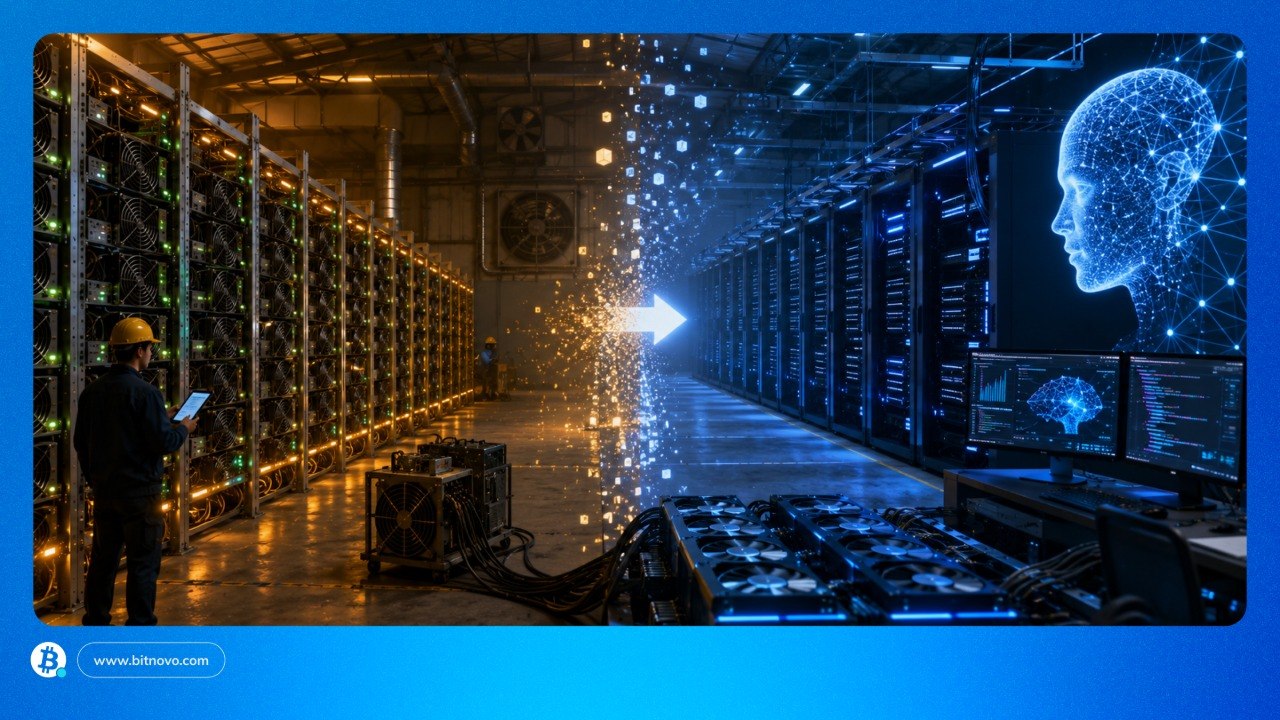
The classic image of cryptocurrency farms, immense sheds full of roaring computers devouring electricity, is changing completely. Bitcoin mining is going through its most critical moment since 2018 due to falling profitability, the impact of the last halving, and fierce competition. The solution for many giants in the sector? Finding an unexpected lifeline in Artificial Intelligence (AI).
In recent months, top industry companies like Bitfarms, Core Scientific, Riot, and MARA Holdings have begun dismantling part of their crypto operations. Their new goal? Adapting that gigantic electrical and physical infrastructure to process AI data, signing multi-million dollar contracts with titans like Google, Microsoft, and Amazon.
In reality, traditional mining faces gigantic challenges: sky-high energy costs, strict environmental regulations, and network difficulty at all-time highs that crushes profit margins.
Faced with this, jumping into AI is a decisive move for three simple reasons:
- Demand:Companies around the world need enormous computing power to train their AI models.
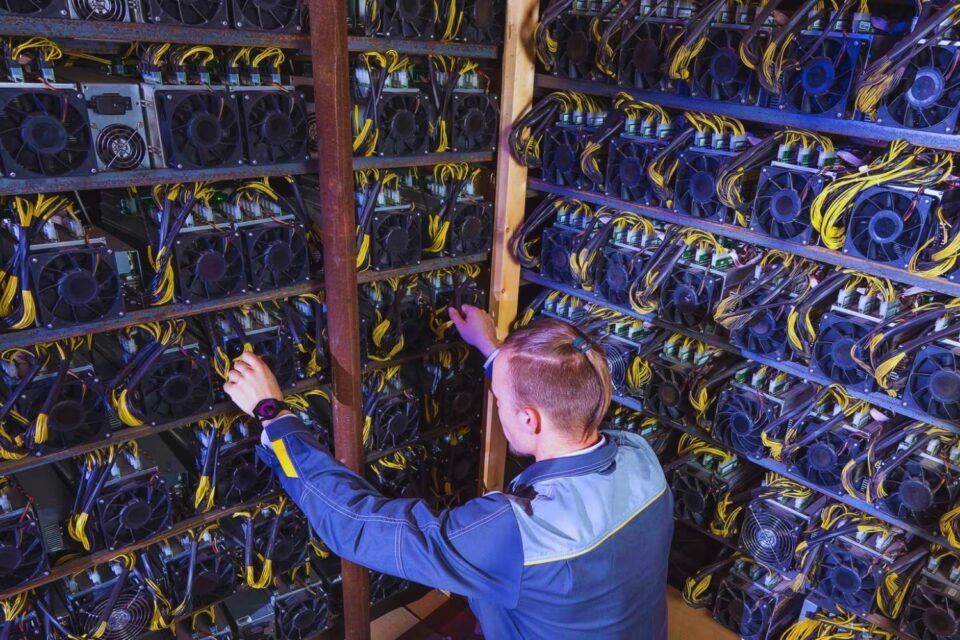
- Ready infrastructure: Mining farms already have the electrical power and cooling systems needed. You just have to change the chips.
- Stable revenue: Offering computing services for AI today is much more profitable and predictable than depending on the ups and downs of Bitcoin’s price.
Facilities built to move terawatts of hashrate are steadily transforming. While some companies are making a gradual transition, others are seeking to completely convert before 2027.
This strategic shift redefines the future of technology, opening a key debate for the ecosystem: if large corporations move to AI, who will be responsible for sustaining and securing the Bitcoin network in the future?

Why Bitcoin mining has become less profitable
Bitcoin mining is suffering severe financial strangulation caused by three simultaneous factors:
- The halving:The April 2024 event suddenly cut the block reward from 6.25 to 3.125 BTC. With revenues cut in half without electricity costs or hardware investment decreasing, the cost of producing each Bitcoin automatically doubled, destroying profit margins.
- Network difficulty: The entry of corporate giants and more powerful equipment has pushed mathematical complexity to all-time highs. More energy is now needed to compete for a smaller slice of rewards.
- Stagnant price: A 30% drop in Bitcoin’s value from its 2025 highs has finished squeezing profits.
In mid-November, data from CoinShares confirmed that very few public mining companies were profitable. As Charles Chong, former strategist at Foundry, summarized: «If I buy a mining machine today, I don’t know if I’ll get my money back.»

Faced with this adverse scenario, AI has become a strategic way out. Mining companies are converting their facilities due to the advantages this sector offers:
- Stable revenue:AI clients sign multi-year contracts with predictable margins, eliminating cryptocurrency volatility.
- Valuable infrastructure: Mining centers already possess the most sought-after assets for AI: massive access to electrical energy and industrial cooling systems.
Thus, infrastructure once dedicated to solving Bitcoin blocks is now being revalued by processing neural networks.
A mining farm’s infrastructure is more valuable than it seems
This transition towards AI reveals that the true treasure of mining companies did not lie in cryptocurrencies, but in their facilities. What makes a mining farm valuable is not the machines themselves, but their critical components: access to large-scale electrical energy contracts, advanced industrial cooling systems, low-latency connectivity, and modular structures capable of housing high-power hardware.
This infrastructure is exactly what AI data centers need. While building a plant with these characteristics from scratch can take years, converting an existing mining farm takes only months.
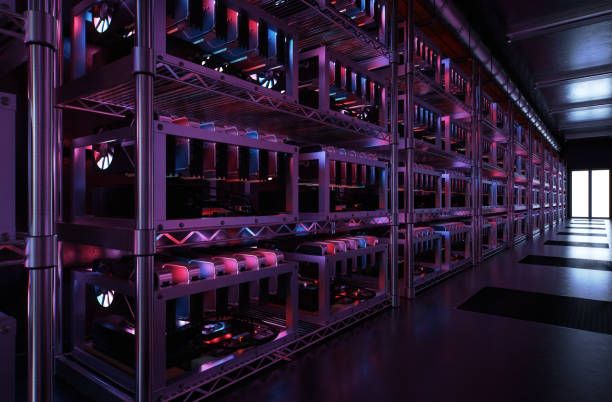
Ironically, the logistical model that Bitcoin built is perfect for AI. What once housed ASIC devices designed exclusively to solve cryptographic puzzles is now being filled with GPU racks, essential for training language models and neural networks.
Incidentally, Meltem Demirors, from Crucible Capital, explains the phenomenon clearly: «Bitcoin mining created the modern data center model. Now they’re just unplugging the miners and making room for their new tenants to bring in the GPUs.»
The financial market has strongly rewarded this metamorphosis. The shares of mining companies that have evolved towards AI have skyrocketed, already accumulating contracts worth over $43 billion to host high-performance computing in former cryptocurrency facilities. In this way, the sector has transformed a margin-squeezed business into a top-tier technological real estate asset.
The most documented examples: success stories
This trend is not theoretical; the main industry giants are already executing this transition with multi-billion dollar figures, adapting their facilities or acquiring new plants for dual use:
| Company | Partner / Key Operation | Energy Capacity | Details of the agreement and infrastructure | Estimated Financial Impact |
| Core Scientific | CoreWeave (Backed by Nvidia) | 500 MW (Expanded from 200 MW) | 12-year contract signed in June 2024. Modified Bitcoin farms to house Nvidia GPUs, maintaining mining in parallel. | $8.6 billion in revenue over the contract. |
| Bitfarms | Acquisition of Stronghold Digital Mining | Sharon, PA plant (PJM Market) and acquired assets | Designed its new plant for dual use (Bitcoin/AI) and acquired Stronghold in 2024 for its HPC and AI potential. | Corporate diversification to mitigate halving risk. |
The hardware shift: from ASIC to GPU
This conversion is not a simple machine swap, as both sectors use opposite technologies:
- ASIC chips (Bitcoin):Designed exclusively to calculate the SHA-256 algorithm. They are hyperefficient at that single task, but completely useless for any other function.
- GPUs (AI): Graphics processing units capable of handling multiple parallel calculations, an essential quality for training neural networks.
Therefore, jumping from one system to another requires deep re-engineering. Adapting the facilities involves reconfiguring electrical and cooling systems to meet the high technical and capital demands required by GPU clusters.
Those who stay in mining
Despite the massive migration, the sector is not moving in a single direction. Not all companies are willing to jump into AI; some are betting on specialization and extreme efficiency to stay in the original business, either because they have access to very cheap energy or because they consider Bitcoin a strategic asset.
A clear example is American Bitcoin, led by Eric Trump. After debuting as a spin-off from Hut 8, the company explicitly decided not to diversify into AI. Its model is surgical and lean: it does not operate its own facilities, only specialized mining hardware. Thanks to optimized structures and competitive energy rates, they manage to mine a bitcoin at an approximate cost of $50,000. Their vision demonstrates that operational discipline, not reinvention, is their formula for long-term survival.
An open question for the Bitcoin network
If a significant part of mining infrastructure permanently migrates towards artificial intelligence, a question arises that the sector is beginning to honestly consider: What will happen to Bitcoin’s security if global computing power decreases?

The current conversion demonstrates a pragmatic reality: hardware can change, but physical space and access to energy cannot. Although this shift towards AI represents financial relief for corporations, it opens a window of uncertainty for the decentralized network.
If too many operators abandon mining, the ecosystem could become concentrated, theoretically becoming more prone to risks such as a 51% attack, especially as future halvings continue to reduce programmed rewards.
In conclusion, the same infrastructure that was born with the purpose of decentralizing global trust and finance is now mutating to support the physical backbone of the AI revolution, completely reconfiguring the world’s technological map.