




The profile of the crypto user has been recognisable for years: a young adult with their own income, comfortable with new technologies, and with a more distant relationship with traditional financial institutions than the previous generation. This is not a perception. European market data backs it up — and so does our snapshot.
What seven years of analysis adds is not a change to that picture. It’s that every year that passes, young people are betting more on cryptocurrencies.
The centre still holds at 25–39, but:
Throughout the entire period analysed, the 25–39 age group has concentrated the largest share of cryptocurrency users. This is consistent with what the ECB documents for the eurozone, where this group has the highest probability of holding cryptoassets.
It is also the segment that has personally managed the transition between traditional banking and the digital economy: with real financial experience, sufficient technological exposure, and the capacity to make financial decisions independently.
The Spanish context reinforces this. The Banco de España puts the share of consumers with cryptoassets at 9% in 2024. Of that group, 19% use them exclusively for payments and 20% for both payments and investment. Usage can no longer be explained by speculative interest alone.
The ecosystem is getting younger
When analysing the current composition of the crypto market in Europe, the most relevant figure is not who leads today. It is the distance between where it was five years ago and where it stands now.
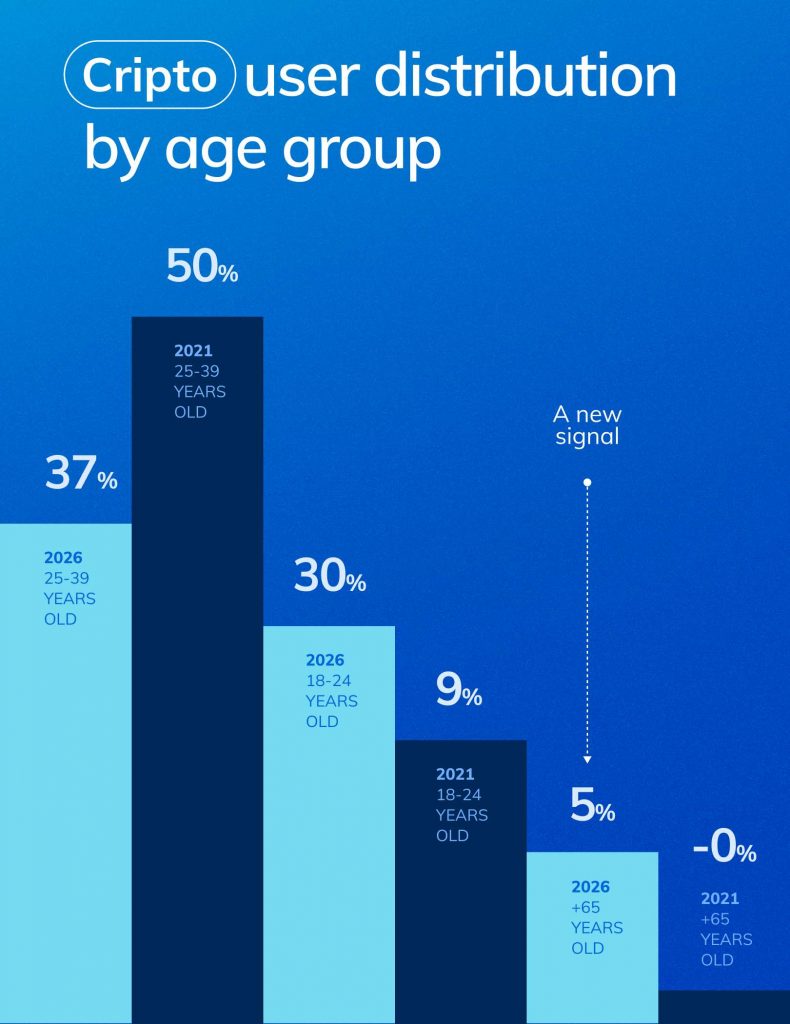
The 18–24 age group has tripled its share. That shift did not happen overnight, nor does it coincide with a single market cycle. It accumulated consistently over several years until it became the new baseline.
Since that equilibrium settled, it has not moved. The 25–39 group remains the most representative, but it is ceding ground. The 18–24 bracket is gaining it. The direction is clear.
One possible reading is that entering the crypto ecosystem no longer requires a moment of deliberate conviction. For a growing share of new users, it is not the result of months of careful deliberation. It is simply the next step in their relationship with money.
There is a figure at the opposite end that deserves a separate note: the 65+ age group, which five years ago was practically non-existent, has developed a sustained presence. Its emergence confirms that older generations can also be drawn to cryptocurrencies, widening the ecosystem in both directions.
What the data says as a whole
The crypto market in Europe has a younger profile today than it did five years ago. That shift is not in dispute: the numbers show it clearly and have been pointing in the same direction for years.
But the more interesting reading is not today’s snapshot. It is that this rejuvenation has stabilised without reversing. The 25–39 group remains the core. The 18–24 bracket has gained a weight it did not have and has held it. And the 65+ has appeared where it did not exist before.
“These figures not only confirm that digital natives are the most interested in cryptoassets, but that usage consolidates and endures over time — proving that whoever knows this technology does not stop using it.” Javier Castro-Acuña
Three distinct movements. All pointing to the same conclusion: crypto adoption in Europe no longer depends on a single profile to grow. It is happening across more age groups, with less friction, and without needing a prior moment of conviction.
Crypto adoption is young. And every year that passes, it gets younger.
Valencia – April 2026 – Bitnovo
Source: Bitnovo internal data