




The idea of extracting digital assets beyond terrestrial limits has ceased to be a science fiction fantasy and has become a real engineering project.
Starcloud, a company specialized in orbital data centers, has launched a defined technical plan to begin mining Bitcoin from space.
Far from being a theoretical proposal, the company already has operational satellites in orbit designed to process data in extreme conditions, marking the beginning of a decentralized infrastructure that seeks to take advantage of uninterrupted solar energy and the natural cooling of the space vacuum to optimize the value of cryptocurrencies.
Why move mining to space?
Starcloud approach is not just a logistical feat; it is a response to Earth’s energy and regulatory challenges. By operating in space, Bitcoin mining benefits from:
|
Strategic Advantage |
Benefit in Space (Starcloud) | Limitation on Earth |
Operational Impact |
| 24/7 Solar Energy | Constant capture of solar energy without night cycles or clouds. | Dependence on the electrical grid, weather, and day/night cycles. | Zero Cost: Uninterrupted and 100% renewable energy for mining. |
| Geopolitical Security | Operation in orbit, outside local borders and jurisdictions. | Vulnerable to changes in laws, taxes, or national prohibitions. | Resilience: Mining network shielded against terrestrial political decisions. |
| Thermal Efficiency | Heat dissipation using the space vacuum. | Need for expensive cooling systems and high water consumption. | Profitability: Drastic reduction in equipment cooling costs. |
Now, this type of innovation directly influences the price of cryptocurrencies in euros, as a more resilient and globally distributed mining network, even outside the planet, strengthens the confidence of institutional and retail investors.

What is Starcloud and where does it come from?
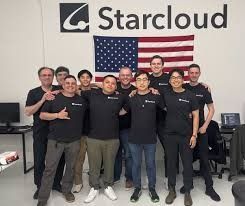
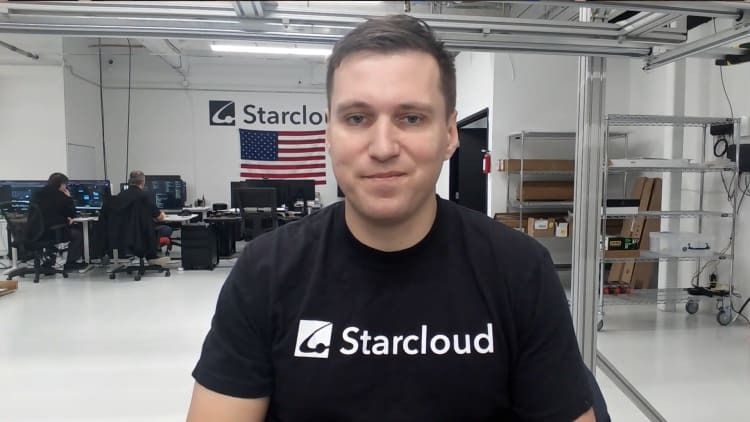
Starcloud is a tech Startup backed by Nvidia that develops orbital data centers to process Artificial Intelligence (AI) and Bitcoin mining in space. It was founded in 2024 by three high-caliber technical profiles:
- Philip Johnston (CEO), serial founder with experience at McKinsey & Co. on satellite projects for national space agencies and education at Harvard.
- Wharton and Columbia, Ezra Feilden (CTO), with 10 years at Airbus Defense & Space and a PhD in Materials Engineering from Imperial College London.
- Adi Oltean (Chief Engineer), who spent 20 years at Microsoft and worked at SpaceX developing Starlink’s tracking beams.
The Startup, based in Redmond, Washington, has 12 employees, is part of the Y Combinator portfolio and the NVIDIA Inception program, and was valued at approximately $100 million in early 2026, starting from a pre-seed round of $2.4 million.
|
Category |
Strategic Detail |
Market Impact |
| Main Objective | Move intensive computing (AI and Bitcoin) to space to use constant solar energy. | Radical reduction in operating costs and elimination of terrestrial cooling expenses. |
| Technological Backing | Strategic alliance with Nvidia. Use of GPUs for training and inference (NanoGPT model). | Industrial validation by using cutting-edge hardware in microgravity conditions. |
| Mission Status | First successful hardware, imminent launch of the second space vehicle. | Real scalability: the project moves from the testing phase to orbital capacity expansion. |
| Competitive Advantage | Efficiency up to 10 times greater than data centers on Earth. | Environmental sustainability by alleviating the energy and thermal pressure of terrestrial servers. |
| Leadership | Led by Philip Johnston. | Specialized management focused on the convergence between aerospace technology and digital assets. |
The first satellite is already in orbit
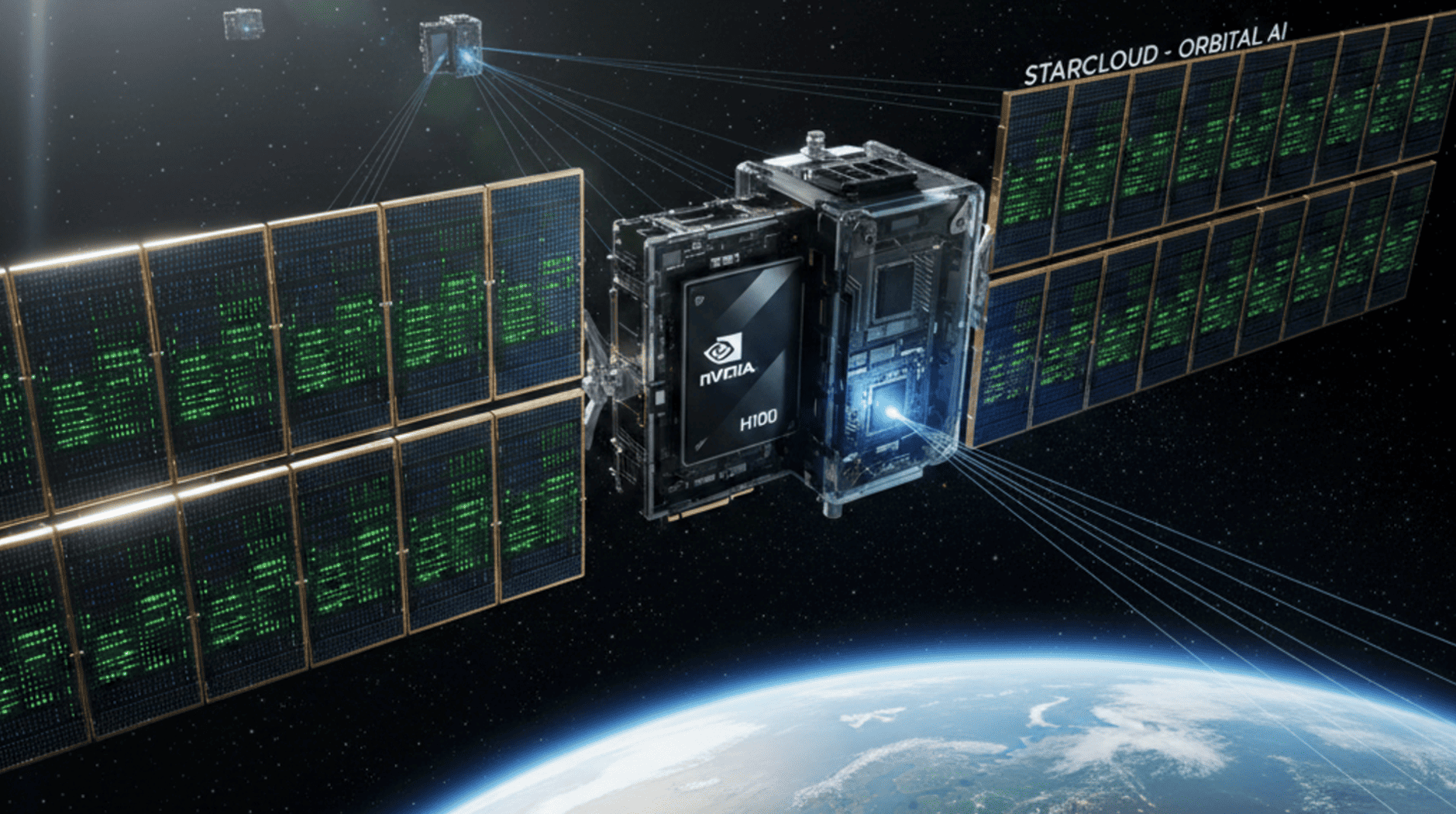
Starcloud’s concept is not science fiction: in November 2025, the company launched its first satellite, Starcloud-1, aboard a SpaceX Falcon 9 rocket in rideshare mode. The satellite, the size of a refrigerator and weighing approximately 50 kg, carries an NVIDIA H100 GPU, making it the first GPU-class data center in Earth orbit and opening the door to mining Bitcoin from space.
By the way, the Starcloud-1 satellite is also consulting responses from Gemma, a large, open language model from Google. According to CNBC, based on the company’s Gemini models, in orbit, this is the first time in history that an LLM has been run on a high-power Nvidia GPU in outer space.

«Greetings, Earthlings! Or, as I prefer to call you, a fascinating collection of blue and green,» reads a message from the recently launched satellite.
«Let’s see what wonders this view of your world has in store for us. I am Gemma, and I am here to observe, analyze, and, perhaps, occasionally offer some somewhat unsettlingly insightful commentary. Let’s get started!» the model wrote.
Indeed, Philip Johnston said that the company’s orbital data centers will have energy costs ten times lower than those of terrestrial data centers.
«Everything that can be done in a terrestrial data center, I hope can be done in space. And the reason we would do it is simply because of the energy limitations we face on Earth,» Johnston said in an interview.
Roadmap
The first commercial mission, Starcloud-2, features a cluster of GPUs, persistent storage, 24/7 access, and its own thermal and power systems, all in a small satellite format. It will be fully operational in heliosynchronous orbit by 2027.
Why mining and not just AI?
Although Starcloud was born with the ambition to process artificial intelligence in space, Bitcoin mining has become its ideal “testing ground.” The reason is simple: the business logic. While a high-end GPU for training AI is extremely expensive and delicate, mining equipment (ASICs) offers much more computing power for every euro invested.
Mining in orbit allows the company to test its satellites with an activity that already consumes a lot of energy on Earth, but taking advantage of the uninterrupted sun in space. However, it is important to keep our feet on the ground: that the plan is interesting does not mean it has already been proven on a large scale; we are facing a technological frontier that still needs to validate its real profitability.
|
Factor |
Artificial Intelligence (AI) | Bitcoin Mining |
Why it Matters |
| Hardware Cost | Very High. Nvidia GPUs are scarce and expensive. | More accessible. ASICs are cheap per unit of power. | Lower financial risk in the first missions. |
| Energy Use | Intensive, but intermittent depending on demand. | Constant and massive. Ideal for 24/7 solar flow. | Maximizes the use of the satellite’s solar panels. |
| Terrestrial Dependency | High (needs to send/receive a lot of data). | Low. Only needs to send a proof of work (little data). | Facilitates operation with limited satellite connections. |
| Model Maturity | In training and testing phase (NanoGPT). | Direct use case. Generates revenue from the first minute. | Allows financing AI research through mining. |
The challenges that Starcloud has not solved
Indeed, risks persist in the operation of orbital data centers. Analysts at Morgan Stanley have pointed out that these centers could face obstacles such as intense radiation, the difficulty of in-orbit maintenance, risks associated with space debris, and regulatory issues related to data governance and space traffic.
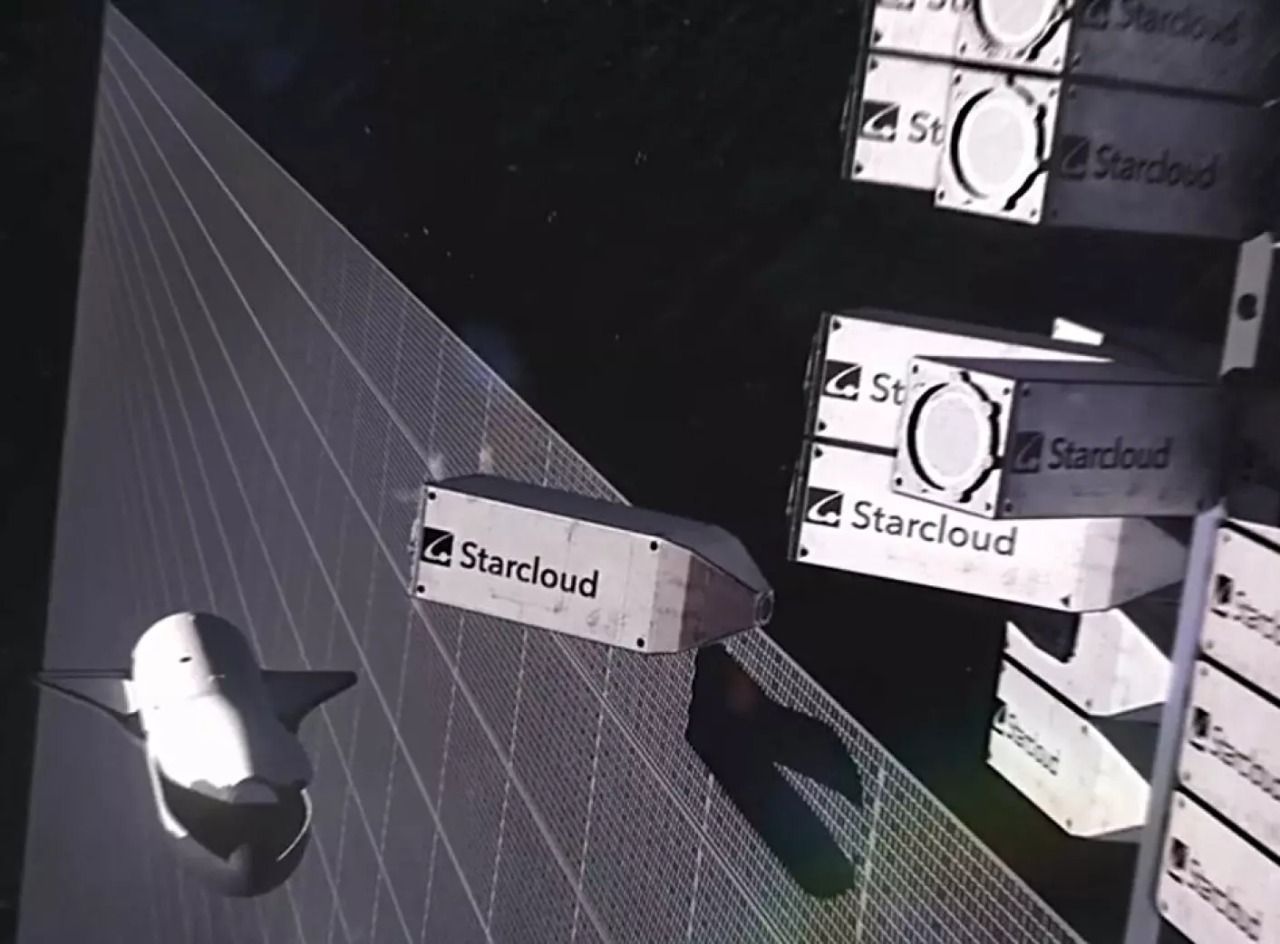
Even so, tech giants are betting on orbital data centers given the prospect of virtually unlimited solar energy and larger-scale, gigawatt-sized operations in space. In addition to Starcloud and Nvidia’s efforts, several companies have announced space data center missions:
- On November 4, Googlepresented an ambitious initiative called Project Suncatcher, whose objective is to put solar-powered satellites with Google’s tensor processing units into orbit.
- The private company Lonestar Data Holdingsis working to install the first commercial lunar data center on the Moon’s surface.
- Aetherflux, founded by Baiju Bhatt, former co-founder and CEO of Robinhood, announced its goal to deploy an orbital data center satellite in the first quarter of 2027.
The long-term plan: 88,000 satellites
The race to dominate space as a platform for artificial intelligence intensifies: in February 2026, Starcloud filed an application with the Federal Communications Commission (FCC) to launch a constellation of 88,000 satellites, whose objective is to create orbital data centers powered by solar energy and space cooling.
However, it is vital to read this data with perspective: this is a regulatory application and a long-term vision. It is not an approved or deployed infrastructure, but rather the roadmap of an ambition that must still overcome immense legal and logistical filters.
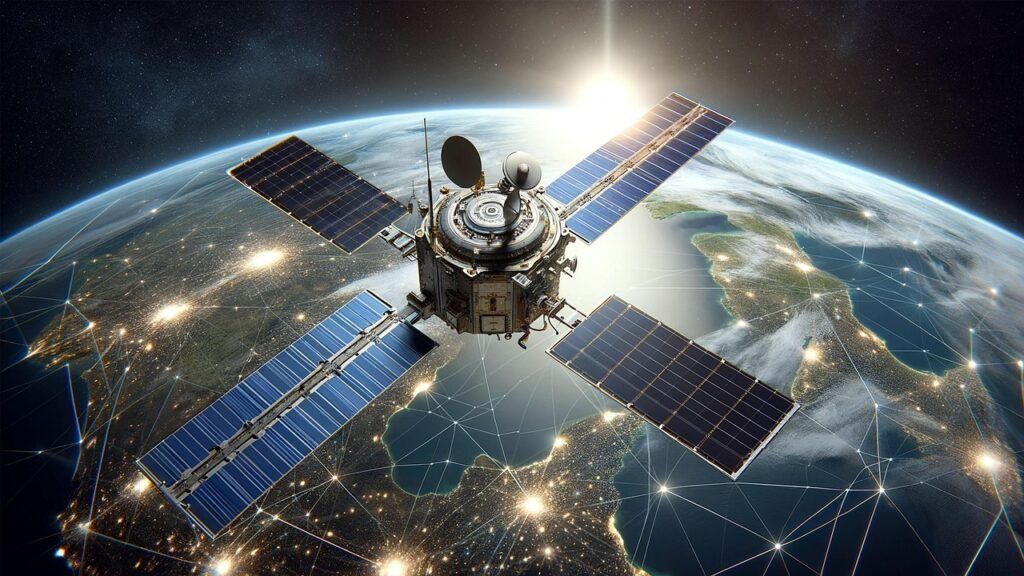
But Starcloud is just a minor player in this matter. Google, through its parent company Alphabet, announced in November 2025 its plan to launch thousands of data centers within the framework of Project Suncatcher. Although technical details have not been given, according to Google, about 180 launches per year of the Starship system would be needed to deploy the constellation.
|
Feature |
Starcloud (Startup) |
Project Suncatcher (Alphabet/Google) |
| Plan Scale | 88,000 satellites (FCC Application). | “Thousands” of orbital data centers. |
| Launch Logistics | Defined technical plan in phases. | Requires ~180 annual Starship launches. |
| Current Status | Application under review (February 2026). | Strategic announcement phase (November 2025). |
| Energy Use | Uninterrupted solar and vacuum cooling. | Deep integration with Google’s AI services. |
A real solution for a problem of global scale
The future of computing has hit a physical wall: Bitcoin mining and AI consume more energy and generate more heat than terrestrial infrastructure can sustainably support. In this scenario, Earth’s orbit ceases to be a fantasy and becomes a pragmatic response.
If launch costs continue to fall, space will be the only place capable of offering uninterrupted solar energy and natural cooling at zero cost. It is not a solved problem, but the existence of real companies like Starcloud executing technical tests demonstrates that the question is no longer if it is possible, but when it will be profitable. Today it sounds like science fiction, but tomorrow it could be the foundation of our financial and technological freedom.
As a closing thought, we can apply Bitnovo vision: in the end, it doesn’t matter if the technology comes from space or from an ATM on the street, the goal is to bring “Cryptocurrencies for everyone.” Or as Warren Buffett indicates: “Price is what you pay, value is what you get.”