




In 2026, cryptocurrency mining does not forgive inefficiency. With Bitcoin difficulty hovering around 125 Trillion and the hashrate surpassing 900 EH/s, profitability is no longer measured by raw power, but by the strict margin between electricity cost ($/kWh) and thermal dissipation.
Home mining stumbles over the residential rate (€0.11 – €0.20/kWh) , where operating an ASIC or a GPU rig generates operational losses, added to the logistical challenge of 75 dB of noise and constant heat in the home. Except for obtaining private self-custody without KYC or taking advantage of thermal recovery as winter heating, the domestic model has been ruled out.
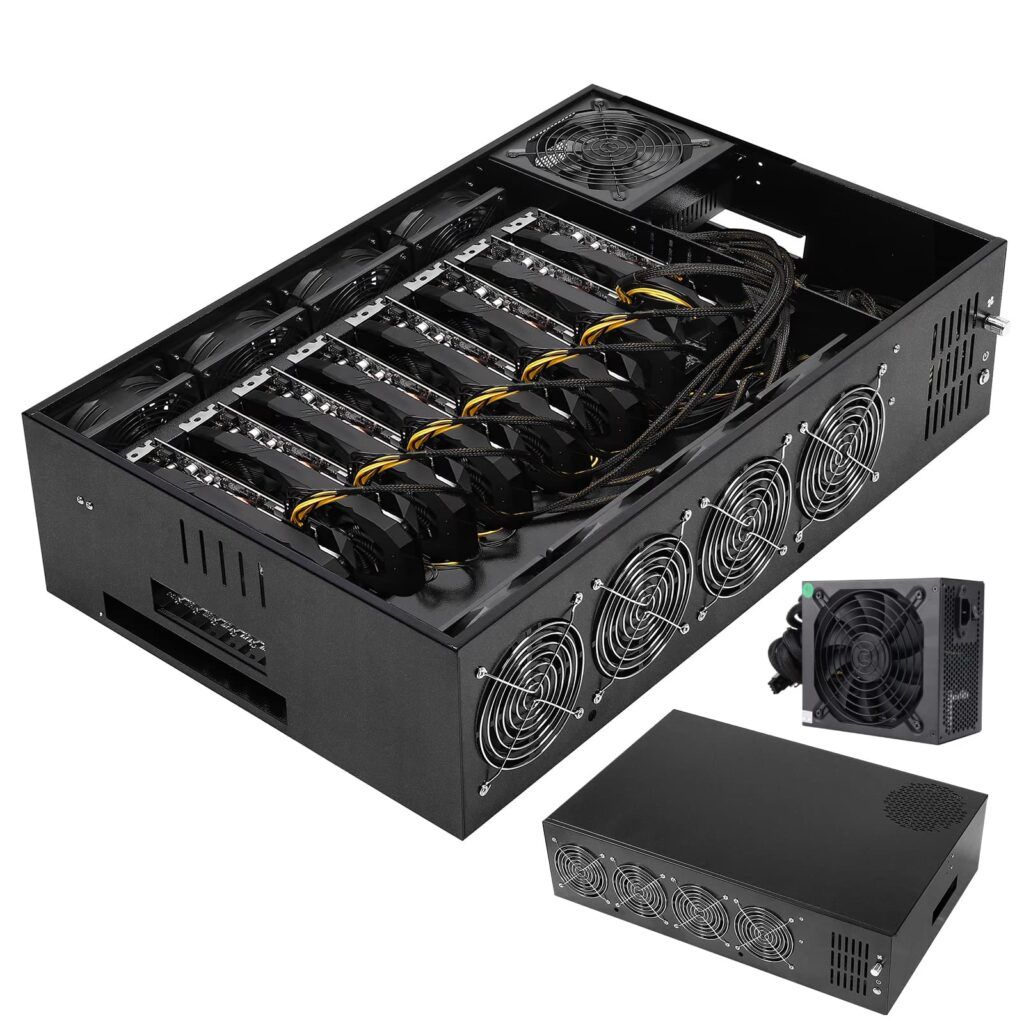
The professional hosting model is the sustainable path: by housing the hardware in specialized data centers, you gain access to industrial rates (€0.04 – €0.06/kWh) , liquid or immersion cooling, and continuous monitoring without overloading your home’s electrical grid.
The practical rule for 2026 is straightforward: if your residential rate exceeds €0.07/kWh, home mining does not sustain a business model. Profitability demands professional scale; the home is left for experimentation, privacy, or smart climate control.
What Exactly Is a Mining Rig
A mining rig is a specialized computer system optimized exclusively to solve the consensus algorithms (Proof-of-Work) of a blockchain network, validating transactions in exchange for receiving a cryptocurrency reward. Unlike a conventional computer designed for general tasks, a rig concentrates all its computing power on executing cryptographic operations uninterruptedly.
Comparison: GPU Rig vs. ASIC Rig
|
Feature |
GPU Rig (Graphics Processing Unit) |
ASIC Rig (Application-Specific Integrated Circuit) |
| Architecture | Adjustable commercial components (multiple graphics cards). | Closed hardware manufactured exclusively for a single algorithm. |
| Flexibility | High: Allows switching algorithms or cryptocurrencies (Altcoins). | None: Only mines the algorithm it was designed for (e.g., SHA-256). |
| Power and efficiency | Moderate hashrate, higher consumption per unit of computation. | Extremely high, maximum efficiency in its specific algorithm. |
| Cost and resale | Affordable in parts; components can be reused or sold. | High initial cost; resale value is zero if the algorithm or coin loses value. |
| Target coins | Ravencoin (RVN), Ethereum Classic (ETC), Kaspa (KAS). | Bitcoin (BTC), Litecoin (LTC), Dogecoin (DOGE). |
Home Rig: What to Really Expect
Building a mining rig at home offers valuable technical learning and full hardware control, but it involves significant logistical challenges. While the pros include potential passive income and component reusability, the cons revolve around the direct impact on domestic coexistence: massive heat generation, uninterrupted noise, and a drastic increase in the electricity bill.
Entry-Level ASIC Equipment
For those looking to start with ASIC equipment in residential or low-consumption environments, there are models optimized in size and sound emission:
- Goldshell Mini-DOGE III:~400 MH/s (Dogecoin/Litecoin). Consumption: ~400W. Approximate price: €430 – €600.
- Whatsminer M30S+ (Bitcoin entry-level):~100 TH/s. Consumption: ~3400W. Approximate price: €1,030 – €1,290 (requires electrical adaptation).
- IceRiver KS0 Ultra (Kaspa):~400 GH/s. Consumption: ~100W. Approximate price: €340 – €515 (silent design for desktop).
Electricity Consumption and Noise in an Apartment
Residential operation of a rig directly clashes with home infrastructure and comfort:
- Continuous consumption:A medium GPU rig (6 cards) or an entry-level ASIC consumes between 1,200 W and 3,200 W per hour. This is equivalent to keeping an electric heater running at maximum power 24 hours a day.
- Noise level:Conventional ASICs operate between 70 dB and 80 dB due to their high-speed fans (similar to the noise of a continuous industrial vacuum cleaner). GPU rigs generate between 45 dB and 60 dB.
- Thermal management:Accumulated heat quickly raises the temperature of a closed room, requiring dedicated air extraction. For these reasons, most users end up moving the equipment to storage rooms, garages, or isolated spaces.

Realistic Profitability in Spain
With the average residential electricity rate in Spain (assuming an average of €0.15 to €0.20/kWh including taxes and tolls), profitability requires a strict calculation:
|
Parameter |
Estimate |
| Daily electricity cost (Rig 1,500W) | ~36 kWh/day (~€5.40 – €7.20 / day) |
| Return on Investment (ROI) | Uncertain, varies according to network difficulty and cryptoasset price. |
| Break-even point | The equipment is only profitable if the daily mined value exceeds the fixed electricity cost. During bear market periods, operating at the domestic level usually generates net losses. |
Professional Rig: When It Makes Sense
The leap from a home rig to a professional installation is justified when the power consumption exceeds residential electrical limits (generally from 3.5 kW to 5 kW of continuous consumption) or when the thermal and acoustic impact makes coexistence impossible. At this point, mining stops being a technical hobby and requires an industrial management model.
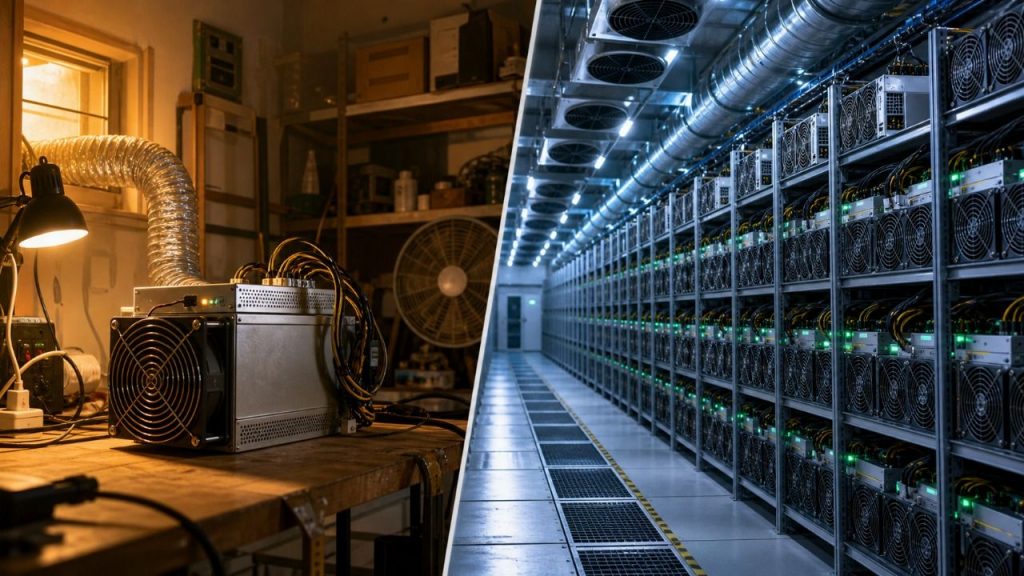
Medium-Scale Home Farms
Operating medium-scale mining in a private property requires a complete infrastructure transformation:
- Dedicated electrical installation:A set of 10 average ASICs demands between 30 kW and 35 kW. It is mandatory to contract an industrial three-phase supply, install high-sensitivity differential magnetothermal protections, and replace standard wiring with thicker sections.
- Climate control and airflow:Conventional air conditioning is not enough. High-volume industrial extractors are required to create a direct airflow circuit that prevents thermal stagnation.
- Legal aspects and permits:High continuous consumption attracts inspections. It is necessary to verify local urban planning regulations, have an electrical certificate signed by a certified installer, and comply with acoustic emission limits to avoid penalties for disturbing neighbors.
Colocation in Data Centers
The hosting or colocation model consists of sending your own ASIC equipment to a specialized data center (mining farm) designed for high energy density.
|
Concept |
Details and typical costs |
| Electricity rate (All-in) | You pay a fixed fee per kWh negotiated by the farm, usually between €0.05/kWh and €0.08/kWh (significantly lower than residential). |
| Maintenance and space | Monthly fee for rack space, 24/7 monitoring, physical security, and remote reboots. |
| Additional services | On-site hashboard repair, industrial air filtration, and liquid or immersion cooling systems. |
Cloud Mining and Its Risks
Cloud Mining allows you to rent computing power from a remote provider without buying physical hardware. Although it seems the most accessible option, it presents serious structural risks:
- Contract structure:You pay an initial fee for power rental plus a fixed daily maintenance and electricity commission.
- Red Flags:Promises of fixed or guaranteed profitability, lack of auditable proof of the real data center, and multi-level referral schemes.
- The profitability trap:If the market drops or network difficulty rises, fixed maintenance costs consume the entirety of the mined cryptocurrencies. Most contracts include automatic cancellation clauses if net performance is negative for several consecutive days, resulting in the loss of the invested capital.
What Has Changed in 2026 with the Difficulty Drop
The year 2026 has accumulated ten downward adjustments versus seven upward ones on the Bitcoin network, placing difficulty near its annual lows (~125.8 T). This reduction (more than 15% from the peaks at the start of the year) responds to the temporary disconnection of inefficient machines and operational stoppages in massive facilities.
- Increased yield per machine:Lower difficulty means active miners obtain slightly more sats or block fractions per TH/s deployed.
- Temporary respite window:The hashprice has experienced brief relief. However, if the Bitcoin price rises, the disconnected power usually rejoins quickly, returning difficulty to higher levels.
Taxes and Fiscal Obligations of Mining in Spain
In Spain, cryptocurrency mining is not exempt from tax control and requires compliance with several obligations with the Tax Agency:
- Registration with Treasury and Social Security:It is considered an economic activity (IAE heading 831.9 or similar). The miner must register as self-employed or incorporate a company if the activity is continuous.
- Income Tax / Corporate Tax:Mined blocks and rewards are taxed as income from economic activities at market value at the exact moment they are received in the wallet. Direct production expenses (such as the electricity bill or hardware depreciation) are deductible.
- VAT implications:According to the criterion set by the General Directorate of Taxes (following the EU Court of Justice), mining is not subject to VAT, so no VAT is charged when receiving rewards (but it also does not allow deducting input VAT on equipment purchases except in specific structures).
- Subsequent sale of cryptoassets:If the mined cryptocurrencies are later sold for euros or other crypto, the difference between the acquisition value (when mined) and the sale value is taxed as a capital gain or loss.
Frequently Asked Questions About Mining Rigs
- How long does it take to amortize an ASIC in Spain?Between 24 and 36 months in the best case, although at the residential level, the payback is usually uncertain or unattainable due to electricity costs.
- Is mining Bitcoin in 2026 profitable with current electricity prices?No, at the residential level. With rates above €0.12/kWh, electricity absorbs the profit. It only pays off through external hosting (<€0.06/kWh) or photovoltaic self-consumption.
- Can you mine profitably without an ASIC?Not on Bitcoin. On altcoins, it is possible with GPU, but the net profitability after paying for electricity is usually marginal or zero.
- What happens when the next halving arrives?It halves the block reward (the next one will be in 2028, dropping to 1.5625 BTC). If the price does not rise or difficulty does not drop, inefficient miners shut down their equipment.
- Is it legal to mine in a residential apartment?Yes, it is fully legal, as long as profits are declared and local regulations on noise, heat, and contracted power limits are respected.

In conclusion, determining whether cryptocurrency mining should be approached as a home project or a professional operation does not depend on the equipment’s raw power, but on the operational and geographical context: while the industrial miner competes through economies of scale, dedicated infrastructure, and low-cost wholesale electricity rates, residential mining remains severely restricted by conventional grid electricity prices, thermal limitations, and unsustainable noise levels for a domestic environment.
Therefore, the technical and financial viability of a rig is defined by the logistics of where it is installed, the agreed energy rate, and the tolerance margin for heat and noise, making the environment the key factor in the success or failure of the investment.