




Bitcoin network difficulty has fallen 14% from its all-time high recorded this year (when it reached 126.23T), according to data from Luxor’s Hashrate Index.
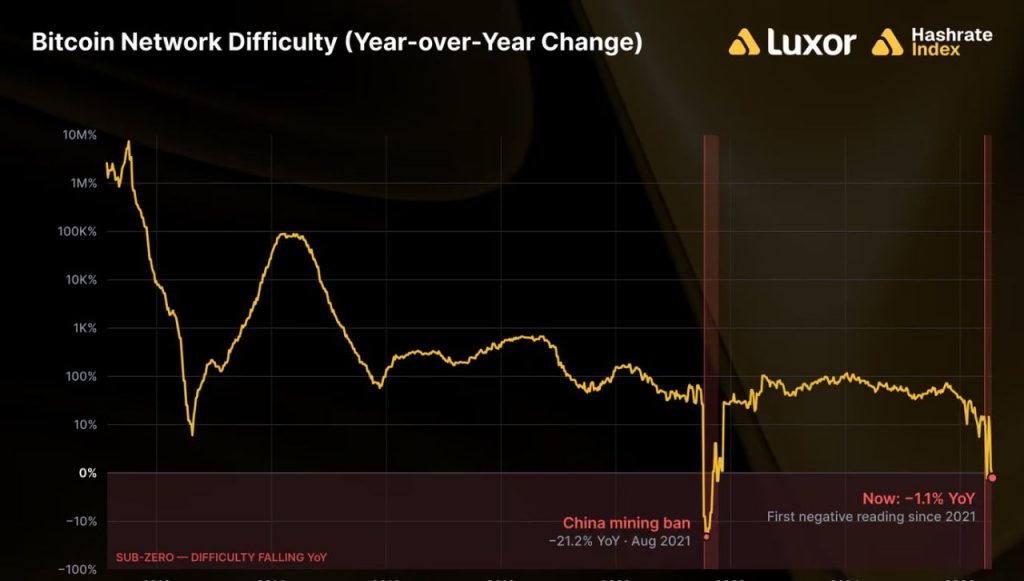
If you are one of those who follows the metric day by day, you will know that this is not just any drop: we are facing the second time in the entire history of Bitcoin that difficulty has fallen in year-over-year terms (~1.1% below where it was twelve months ago). The only time we had seen anything similar was after the massive mining ban in China in 2021.
In this article we are going to understand what is happening without technical jargon or boring language. You will learn:
- What mining difficulty is exactly and how the network self-regulates.
- What a mining rig is and how hashrate works.
- Why the global machine is being shut down, from miner economics to the “attraction effect” of Artificial Intelligence.
Why is difficulty falling? The anatomy of a historic adjustment
Unlike 2021, when China banned mining outright and the network went dark for political reasons, what we are experiencing today is a perfect storm of economics and energy. Simply put: many miners no longer find it profitable to keep their machines running.

The three main reasons behind this adjustment are summarized as follows:
| Factor | What is happening? | Impact on the network |
| Economy in trouble | Weaker BTC prices and compressed revenues. | Profit margins have been reduced to a minimum, forcing the shutdown of less efficient equipment. |
| The AI “attraction effect” | Artificial Intelligence and high-performance computing (HPC) pay better. | Capital, electricity, and operators are moving from Bitcoin mining to AI data centers. |
| Problems in the mining map | Extreme heat waves and electrical restrictions in Texas (a key hub). | Operational interruptions that forced entire megawatts to be disconnected during the hottest months. |
What is a mining rig and what role does it play in the Bitcoin network
A Bitcoin mining rig is not an ordinary computer like the one you use for work or gaming. It is specialized hardware equipment composed of chips designed for a single function: ASICs (Application-Specific Integrated Circuit).
How does it participate in the Bitcoin network?
Bitcoin operates through a consensus system called Proof of Work (PoW). For transactions between users to be valid and grouped into a new “block,” the network requires solving an extremely complex cryptographic puzzle.

The mining rig participates by testing billions of numerical combinations per second until it finds the correct solution. When it finds it, it proves to the other network nodes that it has performed the necessary work, validating the block and adding it to the chain in an indelible way.
Hashrate: Your computing power versus the global network
To understand the capacity of these machines, the term Hashrate (or hash rate) is used, which measures how many mathematical calculations a piece of equipment can perform in a single second.
- Individual Hashrate: It is the computing power that your particular mining rig has (for example, 120 Terahashes per second or TH/s).
- Total network Hashrate: It is the combined sum of the power of all mining rigs turned on around the world at the same time.
In short: the individual hashrate is your brute force contribution, while the total hashrate represents the collective shield that makes the Bitcoin network the most secure and difficult-to-attack computing infrastructure on the planet.
The role of mining rigs in cryptocurrency ecosystems
Mining rigs are critical to the function and security of many blockchain networks, particularly those that employ a Proof of Work (PoW) consensus mechanism. Mining involves verifying new transactions, grouping them into blocks, and adding these blocks to the blockchain ledger. To do this, miners face complex cryptographic problems, which mining rigs are designed to handle effectively.

Miners who manage to add blocks to the chain earn newly minted cryptocurrencies and transaction fees, which motivates them to keep mining. However, not all cryptocurrencies require mining rigs. For example, Ethereum now uses a Proof of Stake (PoS) mechanism, which does not depend on mining.
How difficulty adjustment works in Bitcoin
The difficulty readjustment mechanism constitutes the operational foundation upon which the stability of the Bitcoin protocol is based. Its primary function is to autonomously regulate the complexity of the cryptographic problems required for transaction validation, ensuring that the block generation interval remains consistently at an average of 10 minutes.
This self-regulation ensures predictability in the asset’s monetary issuance and maintains the cadence of network processing, independently of fluctuations in global computing power (hashrate).
The 2,016-block readjustment cycle
The protocol executes this mathematical calibration every 2,016 blocks, a period equivalent to approximately two weeks under nominal operating conditions. The process follows three consecutive phases:
- Real-time metric: The network calculates the exact time taken to solve the last batch of 2,016 blocks.
- Evaluation against the target: It compares that period with the preset target metric of 20,160 minutes (14 exact days at a rate of 10 minutes per block).
- Parametric calibration:
- Upward adjustment: If the execution time was less than 14 days (due to an increase in computing power), difficulty is raised to slow down issuance.
- Downward adjustment: If execution exceeded 14 days (due to the massive disconnection of equipment), difficulty is reduced to speed up the process.
Technical implications of a 14% downward adjustment
A downward adjustment is the algorithm’s response to a substantial contraction in the network’s hashrate. That difficulty has registered a 14% drop from its all-time high this year implies three key technical factors:
- Relaxation of the Cryptographic Target: The numerical threshold that ASIC processors must solve to sign a valid block has become technically 14% less demanding.
- Reduction in relative computing cost: Mining units that remain operational require 14% fewer hash operations on averageto validate a new block compared to the peak reached at the beginning of the year.
- Restoration of block time: This cut compensates for the global processing capacity deficit, correcting the transient slowdown of the network and returning confirmation latency to the 10-minute standard.
The hashrate decline and what is happening on the network
What we are experiencing is not a routine variation: the computing power that protects Bitcoin is registering a historic slowdown.
Between January and June of this year, hashrate fell 17.5% (from 1,066 EH/s to 879 EH/s). It is the first time in five years that the network has closed a first half in negative territory, a phenomenon not seen since the mining shutdown in China in 2021.
A historic setback in figures
The combined impact of the equipment shutdown and the subsequent algorithmic readjustment is summarized in the following key data:
| Metric | Data / Variation | Network context |
| Difficulty Drop (2026) | -14.0% | Progressive decline recorded since the year’s peak. |
| Drop from All-Time High (ATH) | -19.1% | Went from 155.97T (November 2025) to the current 126.23T. |
| Hashrate Drop (Semiannual) | -17.5% | Went from 1,066 EH/s to 879 EH/s between January and July 2026. |
| Historical Comparison | 2nd time in history | Second year-over-year drop in the network’s history (the first was in 2021). |
Why are the engines shutting down? The compression of Hashprice
The main reason is purely economic: operating at a loss is not sustainable. Miner profitability is measured through Hashprice (the estimated revenue for each unit of power contributed).
- The revenue collapse: By mid-2025, hashprice was around €52.10/PH/day. By early 2026 it had already sunk to €32.60, hitting a critical floor of €24.00 at the end of June (a 26.3% semiannual cut).
- The pressure cocktail: With a BTC price hovering around €52,000 (50% below its high of €109,300 reached in October 2025) and difficulty remaining near all-time highs, profit margins evaporated.
- Equipment disconnection: As revenues fall, operators massively disconnect older, less efficient ASIC modelsor migrate their electrical capacity toward AI data centers.
Direct impact on block times
When hashrate collapses rapidly, the network experiences a direct domino effect on processing time:
- Transient slowdown: By suddenly turning off machines, there is less power to solve blocks. During the interval prior to the automatic readjustment, the average time per block exceeds the standard 10-minute target.
- Temporary congestion: Fewer blocks processed per hour imply a greater accumulation of transactionsin the network’s memory.
- Restoration of pace: Once block 2,016 is reached, the algorithm applies the 14% difficulty cut, making cryptographic work more accessible for surviving minersand returning network latency to its usual 10 minutes.
Why operators are reallocating part of their infrastructure toward AI
The sector’s movement does not imply abandoning infrastructure, but rather taking advantage of the base already built. Bitcoin mining farms and AI and High-Performance Computing data centers share two critical elements: massive access to electrical energy and high-density cooling systems.

Reuse of physical facilities
- Electrical infrastructure: Mining facilities already have substations, transformers, and large-scale energy contracts necessary to power AI processors.
- Cooling systems: Cooling technology designed to dissipate ASIC heat is adapted to cool intensive computing servers.
- Infrastructure models: Companies in the sector are reusing their facilities to host AI hardwareor dividing their energy capacity between both industries.
Electrical restrictions in Texas and redistribution of hashrate
Added to this technical reallocation are the geographic factors of key regions like Texas:
- Stress on the power grid: During extreme heat peaks, high energy demand forces data center loads to be paused or limited.
- Operational adjustments: These interruptions in electrical availability have driven operators to diversify and redistribute global computing capacitytoward other regions and types of computing.
What to expect from the network in the coming months
After a downward adjustment, the protocol does exactly what it was designed to do: self-regulate. By reducing the complexity of the cryptographic puzzle, the network rebalances the scales, allowing blocks to be processed again at the standard 10-minute pace and ensuring the smooth flow of transactions.
In fact, if you are concerned about network security in this scenario, the answer is clear: Bitcoin remains as protected as ever.

The 14% drop from the year’s peak in difficulty is not a system failure or a market anomaly; it is a fundamental design feature. Satoshi Nakamoto conceived the automatic readjustment precisely so that the blockchain can autonomously adapt to any variation in global computing power, regardless of how many machines connect or disconnect.
What is truly relevant about this metric is not the figure itself, but the reflection of a mature industry in constant transformation, where part of the energy capacity and installed infrastructure is being redistributed toward new technological fronts such as AI.
As the legendary computer scientist Andreas M. Antonopoulos rightly pointed out: “Bitcoin is not just a currency, it is a system of rules without rulers.”
And it is precisely these automatic rules that guarantee that, no matter what happens on the global energy map, the network continues to advance block by block.
FAQ
- Why did difficulty drop 14%? Due to low miner profitability and the migration of electricity toward AI data centers.
- What is mining difficulty? The metric that self-regulates the complexity to issue a Bitcoin block every 10 minutes.
- How often is it readjusted? Every 2,016 blocks (approximately 14 days).
- Does it affect network security? No. It is a self-regulation mechanism designed by Satoshi Nakamoto to keep the network functional.
- Why is there a migration to AI? Because it reuses existing electrical infrastructure and generates greater profitability.