



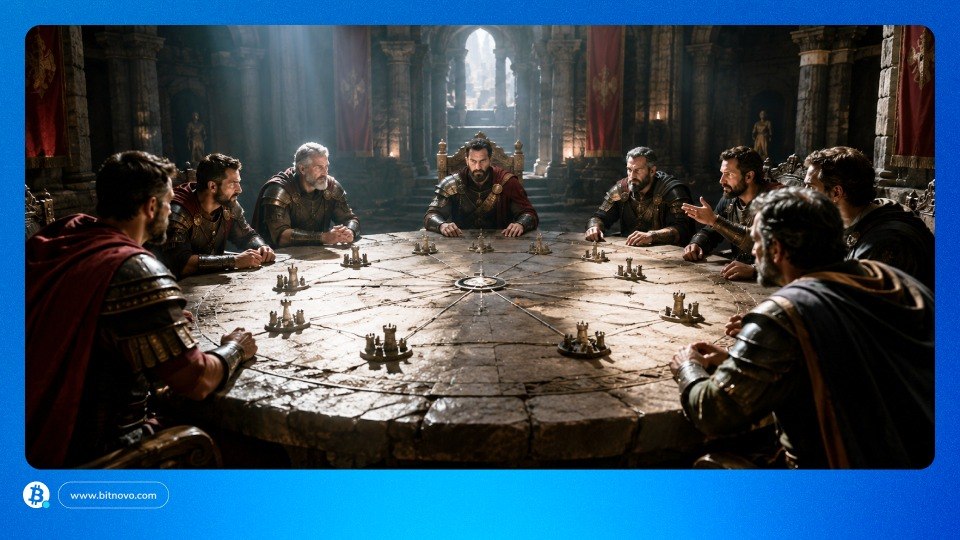
Before Bitcoin, computing had a great unsolved dilemma: how to get a group of people to agree on the Internet without knowing each other and without a central bank to control them? This riddle from the 80s is called “The Byzantine Generals Problem,” and its solution gave life to cryptocurrencies.
To understand it easily: imagine several generals surrounding an enemy city. To win, they must all attack at the same time. If some advance and others retreat, they fail.
The problem is that they can only communicate via text messages, and they know that among them there are traitors who will send false orders to sabotage the mission. How can they agree securely if they cannot trust anyone?

The Generals Metaphor
To reason about this dilemma without complicating ourselves with computing, imagine several generals of the Byzantine army encamped with their troops around an enemy city. They have a clear objective, but they are geographically separated and only have two valid options: attack all together or retreat all together.
If the majority advance and a few retreats, or vice versa, the forces are divided, and the army will be massacred. Total coordination is the only path to victory.
Here is where everything gets complicated:
- No direct communication:Being separated, the only way to send orders is through messengers on horseback who must cross enemy territory, risking capture or having the message changed.
- The betrayal factor:The generals know for certain that there are infiltrators among them. A traitorous general could send an “attack” message to half the army and a “retreat” message to the other half, deliberately sabotaging the plan.
- Lack of trust:With no “supreme general” or central authority for everyone to trust blindly, how can loyal officers agree if they don’t know who the traitor is and whether the letters they receive are real?
Achieving consensus in an environment where you cannot trust anyone seemed like a dead end. This scenario, originally proposed by computer scientists in 1982, demonstrated that in an open, leaderless system, a single traitor can completely break communication. A revolutionary solution was needed for a group of strangers to agree securely over a potentially dangerous network.
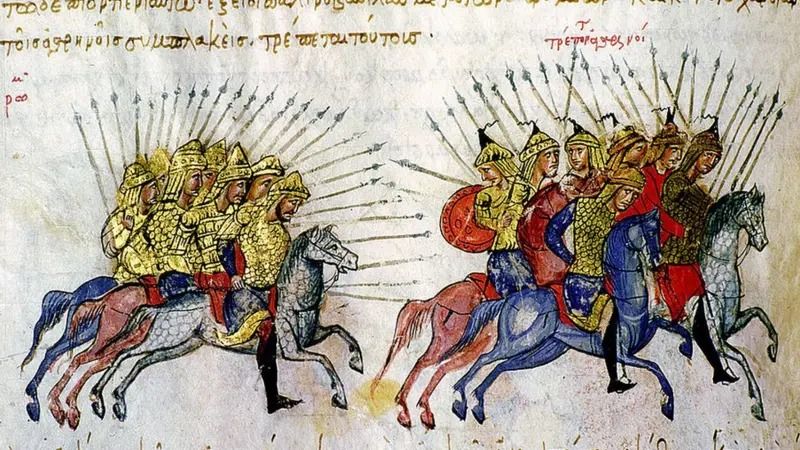
From Metaphor to the Digital World: The Double-Spending Problem
This generals’ conflict did not remain in military history books; it became the headache of computer scientists for decades when they tried to create the Internet and digital money. If we translate the story into today’s technology, the scenario is exactly the same:
- The generals are the computers (or nodes):Computers spread all over the world that form a network and need to synchronize.
- The messengers are the communication channels:The cables and Internet connections through which data travels.
- The traitors are the malicious participants:Hackers or dishonest users trying to double-spend transactions, send false data, or manipulate the system for their own benefit.
In the financial world, the equivalent of a “traitor general” is someone attempting a double spend, i.e., tricking the network into spending the same digital coins twice.

The challenge remained identical: how to get thousands of unknown computers to agree on a single version of the truth without anyone being able to cheat and without relying on a central bank?
For a long time, science mathematically proved that if more than one-third of a network’s computers became “traitors,” the entire system would collapse. It seemed an impossible limit to overcome, and that is why all previous attempts at digital money failed. The real problem was that, without a boss, no one knew what data to trust… until Bitcoin appeared.
Satoshi Nakamoto’s Solution: Blockchain and Proof of Work
In 2008, Satoshi Nakamoto solved this dilemma in the Bitcoin Whitepaper. His genius was to brilliantly combine two elements that transformed trust into a mathematical rule:
- Blockchain:Imagine it as the network’s official ledger, where transactions are grouped into blocks linked chronologically in a mathematical way. For example, if you tried to alter a transaction from three blocks ago, you would have to recalculate and modify all subsequent blocks one by one. This makes rewriting history practically impossible.
- Proof of Work:To validate and add a new block to that ledger, the network’s computers (miners) compete by solving an extremely complex mathematical problem. This process requires a massive expenditure of energy, time, and computing power, meaning you cannot fabricate votes out of thin air.

By uniting both tools, Satoshi Nakamoto completely changed the rules of the game. If a malicious participant tried to cheat or double-spend a transaction, the other nodes would detect it and reject it immediately.
To trick the system, an attacker would need to control more than 50% of all the computing power on the planet connected to Bitcoin. Since attacking the network is infinitely more expensive than participating honestly, cheating ceases to be profitable.
Bitcoin’s rule is simple and automated: the chain with the most accumulated work is the only official truth. This is how thousands of strangers can manage money securely and 100% decentralized, without bosses and without banks.
Why This Matters Regardless of Bitcoin
Solving the Byzantine Generals Problem not only made the birth of Bitcoin possible; it opened the door to a new technological era based on decentralization. The ability to get thousands of strangers to agree without an intermediary is the foundation of everything we build today on Web3. Thanks to this mathematical breakthrough, today we can develop:
- Smart Contracts: Digital agreements that execute automatically when conditions are met, without needing lawyers or notaries.
- Decentralized governance networks: Entire organizations managed by their own users through transparent and inviolable votes.
- Global payment systems: New blockchains and financial platforms that process millions of transactions per second with total security that no one can manipulate the balances.

In short, understanding the Byzantine Generals Problem allows us to see the true value of blockchain technology: it is not just about digital money, but a revolutionary tool capable of transforming the way we trust, collaborate, and make decisions on the Internet.