



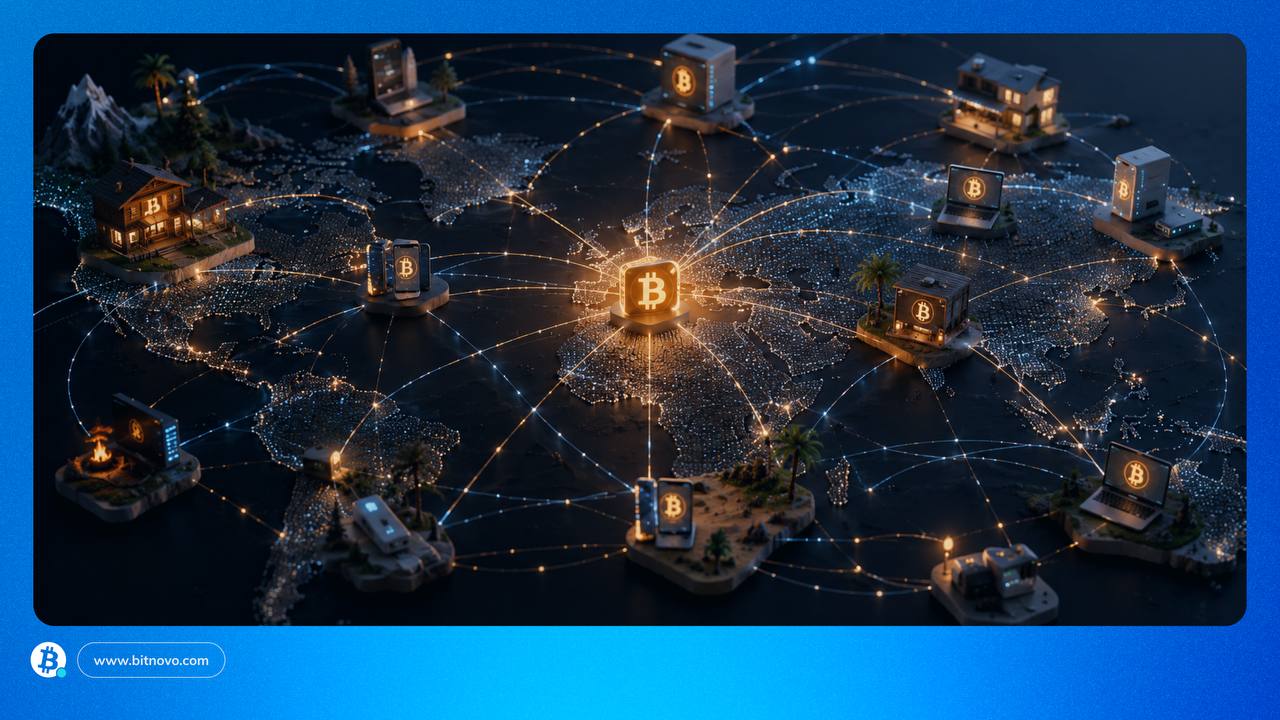
Can you imagine being able to send money or share information with someone on the other side of the world without a bank, company, or government having to authorize it? This is possible thanks to peer-to-peer technology (or peer-to-peer network), a digital model in which participants connect directly with each other to exchange resources without the need for a central server to control them.
Although the concept originally emerged for sharing files on the Internet, its true historical milestone occurred in 2009: Bitcoin was the first decentralized payment system built on P2P technology, demonstrating that it was possible to create a global and secure economy completely without intermediaries.

How a Peer-to-Peer Network Works
Unlike traditional systems where everything depends on a tech giant or a bank, the engine of P2P is absolute decentralization. Its operation is based on three key pillars:
|
Key Aspect |
Operation in the P2P Network |
Why is it revolutionary? |
| The dual role of the node | Each connected computer (node) acts simultaneously as a client and server. It receives and sends information directly to others without intermediaries. | Breaks the monopoly of the central server; users provide the service to each other mutually. |
| Total fault tolerance | There is no central point that can fail, be sabotaged, or controlled. If one node shuts down or is attacked, the network remains active through the thousands of remaining nodes. | Makes the system virtually indestructible and highly resistant to censorship. |
| Community consensus | The verification and validation of transactions are carried out by the network’s own nodes, collectively and mathematically. | Eliminates the need for an “arbiter” or trusted third party (like a bank) to certify what is real. |
Main Characteristics of Peer-to-Peer
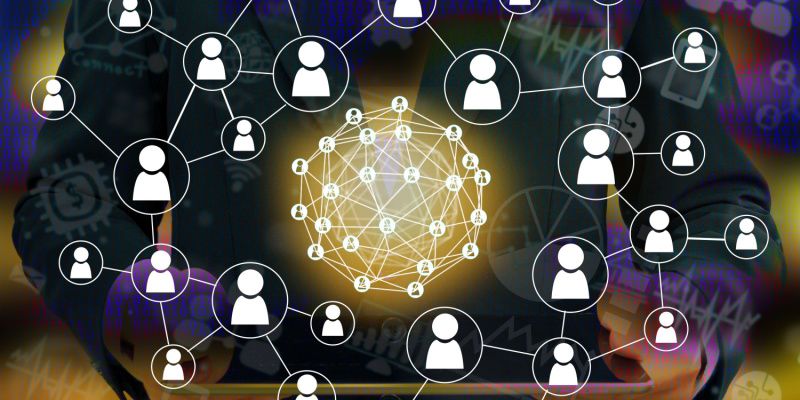
To understand the impact of peer-to-peer technology on the digital ecosystem, it is necessary to analyze the attributes that completely differentiate it from the traditional server model.
|
Characteristic / Model |
What does it consist of? |
Impact on the network |
| Decentralization | No single actor controls the network. Tasks and power are distributed equally among all nodes. | Eliminates intermediaries and prevents the system from being censored or shut down by a single entity. |
| Scalability | Each user who joins contributes their own storage, bandwidth, and processing power. | Unlike traditional servers, the network becomes faster and stronger the more users connect. |
| Simultaneous transfer | Data is sent and received directly and in parallel between multiple nodes at once. | Maximizes transmission speed and avoids speed bottlenecks. |
| Distributed security | Data validation depends on the consensus of all participants, not a central server. | Avoids massive hacks; to alter the network, one would have to attack the majority of computers at once. |
| Unstructured P2P networks | Nodes connected randomly without a fixed order. | Very flexible and easy to create, but less efficient when searching for specific information. |
| Structured P2P networks | Nodes organized in defined positions using distributed hash tables. | Offer maximum efficiency and speed in searches. This is the model used by blockchain technology. |
| Hybrid P2P networks | Combine a central server (for searching or connecting) with direct transfer between nodes. | Facilitate initial access, but the system becomes less decentralized and more dependent on a central point. |

Peer-to-Peer Applications: From Bitcoin to Web3
Peer-to-peer technology goes far beyond the simple transfer of cryptocurrencies. Today, it is the base infrastructure upon which the new generation of the Internet is being built.
Although Bitcoin was the definitive use case that demonstrated that P2P could be successfully applied to massive digital payments, its decentralized architecture has evolved to become the engine of the entire modern crypto ecosystem.
Where is P2P applied today?
- Blockchain Networks:Allow sending and receiving digital assets globally in minutes. The network’s own nodes are responsible for validating, processing, and securing these transactions without banking intermediaries.
- Decentralized Finance (DeFi):Token exchange platforms (DEXs) eliminate the need for a traditional broker or exchange house. Users trade and exchange liquidity directly with each other.
- Decentralized Applications (dApps) and Web3:Unlike traditional apps that host their data on corporate servers, dApps distribute their operations and code across thousands of computers simultaneously.
- Distributed cloud storage:Using P2P protocols like IPFS, files are fragmented and saved across the network of participants. This guarantees that information remains always available and is immune to censorship or system crashes, even if several nodes disconnect.

Advantages and Disadvantages of Peer-to-Peer
To realistically evaluate the impact, it is necessary to analyze both its operational strengths and the technical challenges it presents in its implementation.
|
Advantages of P2P |
Disadvantages of P2P |
| Cost savings: Substantially reduces initial and recurring infrastructure expenses by eliminating corporate intermediaries and central dedicated servers. | Technical knowledge required: Setting up, administering, and securely maintaining a node is often complex for the average user. |
| High reliability: Lacking a central point of failure, the network remains robust and operational independently, even if multiple nodes disconnect. | Presence of malicious nodes: Being open and horizontal networks, there is a risk that participants may distribute malware or try to corrupt data integrity. |
| Global scalability: Processing capacity, storage, and bandwidth increase organically as more users join the network. | Scalability issues by design: If the network or consensus protocol is poorly designed, bottlenecks and slowness can arise during periods of high congestion. |
| Independence and resistance: Users operate directly and under their own responsibility, creating an environment free from censorship or unilateral blocks. | Lack of central governance: Without centralized support, the user assumes total responsibility for their mistakes (such as loss of keys or incorrect sends). |
In conclusion, peer-to-peer is the fundamental technology that makes it possible for cryptocurrencies to operate securely, transparently, and globally without relying on banks, governments, or financial intermediaries. If you want to begin practically exploring the crypto ecosystem and experience the advantages of this decentralized technology, you can take your first steps through Bitnovo.