



Every January 3rd, thousands of bitcoiners around the world perform a simple but powerful “ritual”: they withdraw their cryptocurrencies from exchanges and move them to a self-custody wallet. This is called Proof of Keys Day.
Why is it gaining so much traction? Because many people still live in “comfort mode”: they buy crypto and leave it on an exchange as if it were a bank. And when something goes wrong, you realize too late the fine print: if you don’t control the private keys, you don’t control your crypto.
The stories are plentiful: exchanges that collapse, freeze withdrawals, suffer hacks, or simply “disappear” with users’ money (there are very high-profile cases like Mt. Gox or FTX). Proof of Keys Day was born precisely to combat this normalization of risk: one day a year, we all remember (and practice) Bitcoin’s core idea: financial sovereignty.
What is Proof of Keys Day?
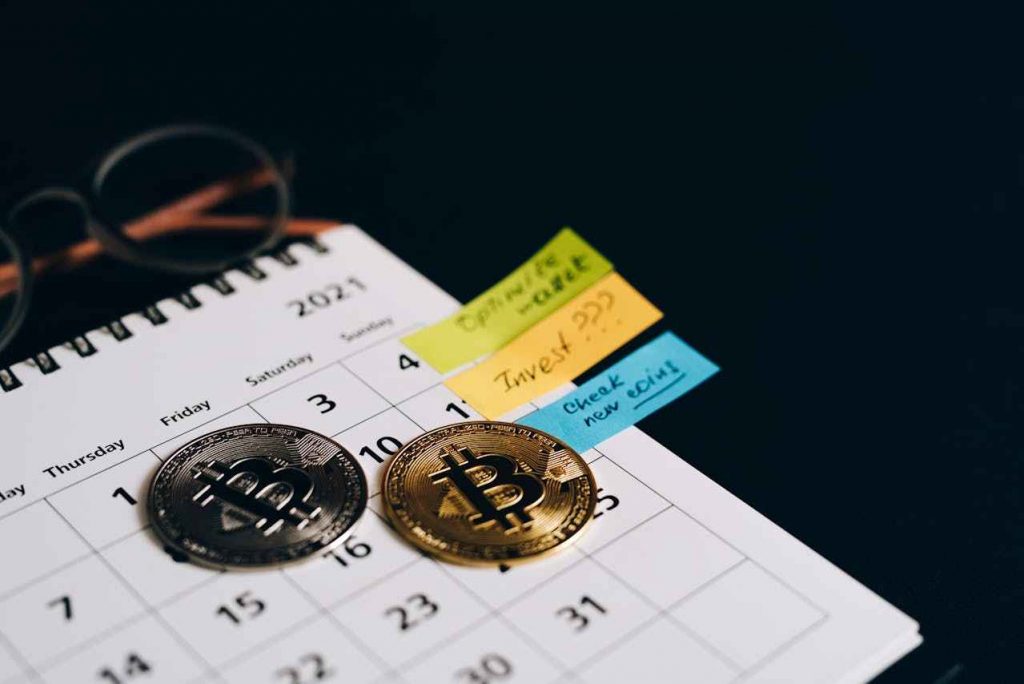
Proof of Keys Day is an annual event celebrated every January 3rd, where thousands of users withdraw their cryptocurrencies from exchanges and move them to self-custody wallets. The golden rule is the phrase everyone repeats but few practice: “Not your keys, not your coins”.
The idea was promoted by Trace Mayer in 2019. It’s celebrated on January 3rd because it’s a very important day for Bitcoin—the anniversary of Bitcoin’s genesis block (January 3, 2009).
That block included a message that many interpret as a critique of the traditional financial system: “The Times 03/Jan/2009 Chancellor on brink of second bailout for banks.”
In practice, Proof of Keys Day serves three clear functions:
- Educate about self-custody: Learn to store your assets without depending on third parties.
- Test custodians: If an exchange says it has X amount, a “mass withdrawal” is a way to test if they’re telling the truth.
- Exercise real financial sovereignty: Not as a nice theory, but as a habit.

How to participate in this event: Step-by-Step guide
To participate in Proof of Keys Day, the idea is simple: you need to take your funds out of an exchange and move them to a wallet where you control the keys. If you’re looking for an option to get started, Bitnovo Wallet is a self-custody wallet—you control the private key and Bitnovo has no access to it.
- Choose your wallet (self-custody hot wallet or cold wallet)
- Create your wallet and save the key (important: never lose it)
- Review your exchanges
- Copy your wallet address
- Withdraw from the exchange
- Paste the address
- Select the correct network (BTC on Bitcoin network, etc.)
- Make a small test withdrawal first
- Verify it arrived
⚠️ VERY IMPORTANT: If you don’t have experience, start doing this ahead of time and with small amounts to avoid surprises on the event day. Also, store or remember your keys very well, as you’ll be responsible for them.
Why is this important? Custody vs self-custody
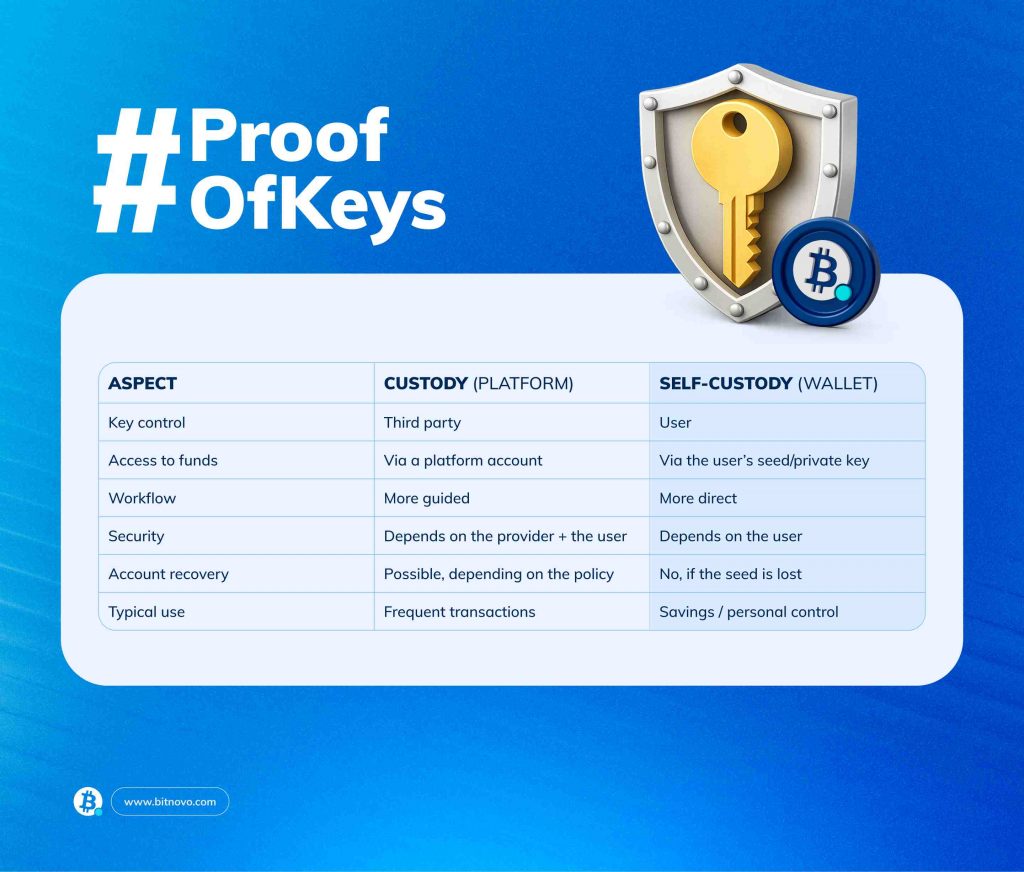
In custody, a third party stores the private keys and controls access to your funds. In self-custody, you store the keys (seed phrase) and manage access directly. The main difference is who controls the keys.
What is self-custody?
Self-custody means you generate and control your private keys, normally through a seed phrase (12 or 24 words). No one else should see or touch it. The main benefit is that if an exchange falls, you don’t fall with it. Your funds are in your wallet, under your keys.
But it also means responsibility. You must know and never lose the seed phrase or give it to anyone, as these keys are your own responsibility. If you want to try a self-custody wallet, you can do so with Bitnovo wallet, where we guarantee that your keys are yours, always.
The problem with exchanges
When you leave your crypto on an exchange, the exchange controls the private keys. You, in practice, have a balance on screen and a promise of payment—a digital “IOU”.
This opens the door to several risks:
- Bankruptcies and mismanagement: If the platform sinks, your funds can get trapped (FTX is a very good example of this).
- Hacks: The industry’s history shows that the weak point is usually centralized infrastructure, not the blockchain.
- Fractional reserves/insolvency: If a custodian doesn’t have everything it claims to have, the problem appears when many try to withdraw at once and it doesn’t have funds to cover it.
That’s why Proof of Keys Day isn’t about “making a withdrawal and that’s it”. It’s about learning to do it right and understanding the importance of custodying your crypto.
When thousands withdraw on the same day, exchanges that work well process it without drama. Those that don’t have the funds they promise give themselves away with excuses, surprise limits, or freezes. A widely cited case from the first edition was HitBTC, where some users reported disabled withdrawals right in the middle of the campaign.
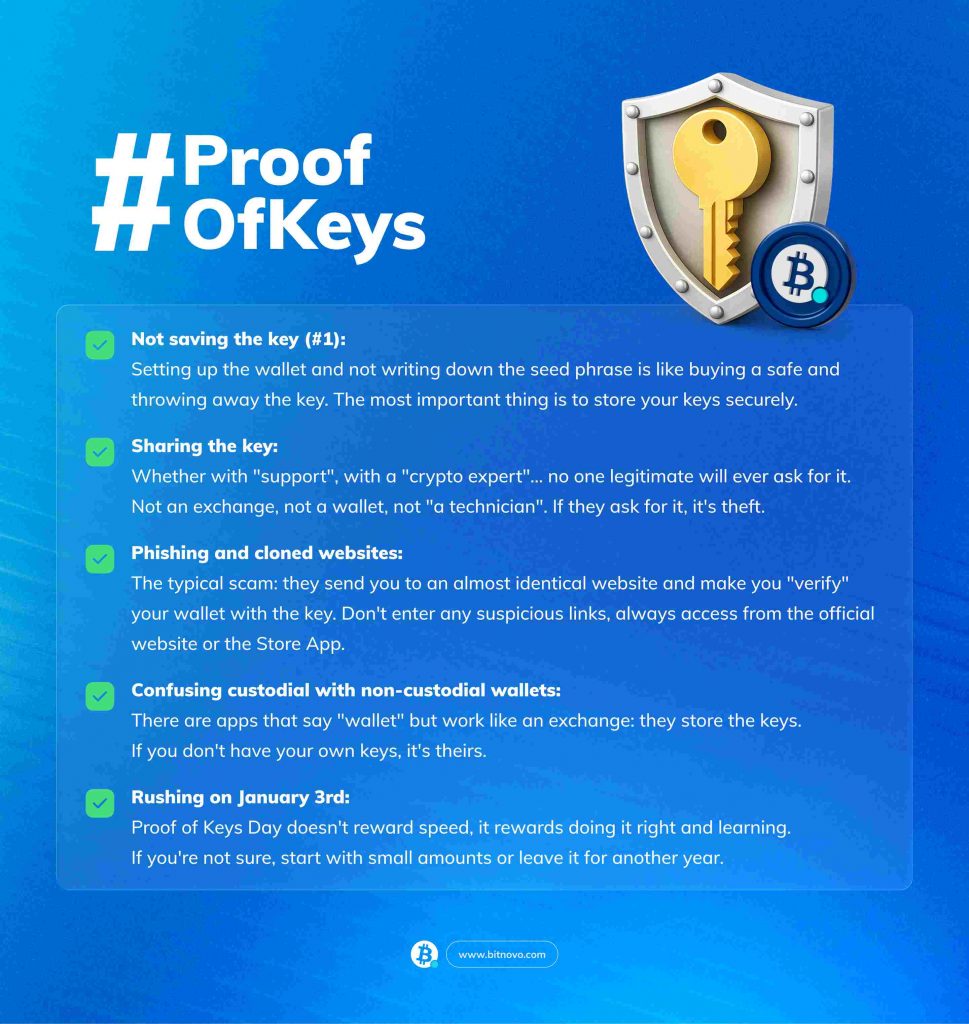
Fatal mistakes to avoid
Impact on the industry
Proof of Keys Day started as a call to action and became an annual reminder of an uncomfortable truth: self-custody is the difference between “having crypto” and “owning your crypto”.
After major sector collapses, the custody debate exploded and pushed many exchanges to talk about transparency, audits, and proof-of-reserves. At the same time, thousands of users decided they were going to custody their own crypto, not delegate it to an exchange.
Want to know if you’re on a legitimate exchange or custody wallet? Easy: when it’s time to withdraw, legitimate exchanges make it easy, dubious ones pull out the “maintenance” sign.
Proof of Keys Day isn’t just 24 hours. It’s a reminder that your financial freedom isn’t delegated. Start small if necessary: with €50, with a single coin, or with a test withdrawal. If it convinces you, you can always switch to a self-custody wallet.
Every person who learns to custody their own assets is a victory for financial sovereignty. The future of money tends to be more open, more verifiable, and less dependent on intermediaries. At Bitnovo we share the same motto: Not your keys, not your coins.