



A Colored Coin is a fraction of Bitcoin to which additional information is assigned so that it represents a specific asset, such as a stock, a bond, or a digital ticket. Through this process of “coloring”, a simple satoshi ceases to be just a monetary unit to become a certificate of ownership or a right to an asset.
This system represented the first milestone of asset tokenization within the blockchain. By allowing Bitcoin’s infrastructure to manage something more than payments, colored coins established themselves as the direct precursors of today’s NFTs and the modern token economy, laying the foundations for the entire ecosystem of digital assets we know today.
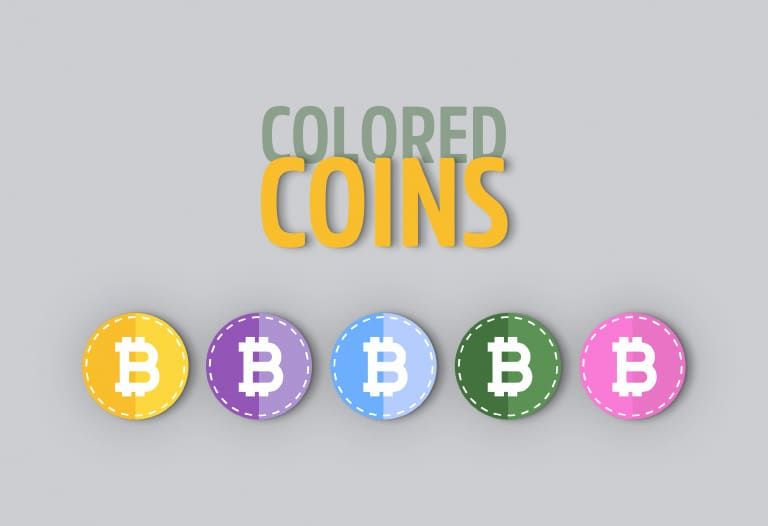
Bitcoin and its layers of value
Bitcoin is much more than a digital currency, it is the most secure and robust decentralized network in the world. Thanks to its immense computing capacity and a public blockchain that no one can alter, Bitcoin offers unprecedented technical trust.
Due to these characteristics, the idea of “leveraging” that maximum-security infrastructure as a base layer for something more than simple payments emerged. Developers saw in Bitcoin the perfect “foundation” for registering other types of values —such as stocks, bonds, or tickets— without having to create a new network from scratch, using the immovable security of its ledger to validate external assets.

What exactly is a colored coin
Colored coins or “monedas coloreadas” were an experiment of the crypto community and, for many, are considered the first NFTs in history. Their main objective was to develop tokens on top of Bitcoin, in order to leverage its incredible power, security, and global reach, using the programming capabilities of Bitcoin Script.
In simple terms, a colored coin is a BTC (or a fraction of it, called a satoshi) that has been “marked” with extra information or metadata. These data give it a special and unique meaning: from that moment on, that fragment of Bitcoin is no longer just digital money, but functions as a “digital ticket” that represents a specific asset or right outside the network.
The use of metadata and Bitcoin Script
Although each colored coin transaction is, in essence, a normal Bitcoin transaction, its operation is based on including additional instructions within its script (specifically in fields like OP_RETURN).

These metadata are invisible to the common user, and only nodes or wallets adapted to the colored coins protocol can understand and execute these special instructions.
“Coloring” UTXOs: the marking of satoshis
The process consists of taking certain satoshis and associating an identity or “color” to them through the input and output pattern of the transaction. It is as if, when making a transfer, an invisible label is placed on those specific coins indicating what they represent (a stock or a bond), allowing the system to track that “color” as the coin changes hands on the blockchain.
History and evolution of the concept
Colored coins arrived thanks to the need to develop new tokens to transfer assets to the Bitcoin blockchain. Thanks to these tokens it was possible to represent anything from the real world on the network. By anything we mean stocks, commodities, real estate, fiat currencies and even other cryptocurrencies. After the emergence of this need, in March 2012 Yoni Assia, promoted the idea of MasterCoin, and with it presented the idea of “colored coin” on his personal blog.

Although at first it was a novel and difficult idea to understand, it began to be accepted by the public and gained the interest of users. A few months later, specifically on December 4th of the same year, Meni Rosenfeld developed a whitepaper that described what colored coins were. This was the first known formal work on a colored coin. It was incomplete, but it still caught the attention of many community members.
By 2013, everything was taking shape and the Colored Coin Protocol by Flavien Charlon was born. This was a protocol that allowed the development of colored coins. For its development, specific configurations in the inputs and outputs of transactions were used. This project represented the first functional colored coin protocol on Bitcoin. However, it took a full year until July 3, 2014, when the creation of the EPOBC protocol by the company ChromaWay took place.
The EPOBC protocol stood out for notably facilitating the development process of colored coins for the developers of this technology. Furthermore, this project was one of the first to use the new OP_RETURN function of Bitcoin Script.

After the development of these projects came others that over time became increasingly important on the Bitcoin network. The birth of protocols like Open Assets and Coinprism, fundamental projects that allowed the standardization and visualization of these assets, making the technology more accessible to the market.
From experiment to precursor of NFTs
To understand the importance of colored coins, one must see them as the original “draft” of what we know today as NFTs and modern tokens. The logic they applied was revolutionary: establishing that a digital token can be equivalent to a real-world asset or right.
This idea of “marking” a digital unit to give it a unique value was the foundation that later inspired the creation of standards on more flexible networks, like Ethereum, with its famous ERC-20 tokens for fungible assets and ERC-721 for NFTs.

Although colored coins had the technical limitations inherent to the Bitcoin network of that time, they laid the conceptual foundation of the entire current tokenization economy: the ability to prove ownership of anything in a public, secure, and digital way.
Utility and practical applications
Companies that want to conduct an Initial Public Offering (IPO) often use colored coins. For example, Coinprism, a colored coin wallet, allows organizations to create an IPO and issue shares in a matter of minutes. Subsequently, the shares can be easily traded via blockchain anywhere in the world.
Effectively, colored coins are a simple way to issue and transfer assets on the Bitcoin blockchain. They can be used to represent smart properties, stocks, bonds, precious metals, etc.
- Creation of collectibles: Colored coins are to some extent very similar to NFTs, in fact, when a payment is made with a colored coin, what is really done is transferring the ownership of that token to the other person, just as happens with an NFT token (like Ethereum’s ERC-721).
- Access and subscription: Use of colored coins to trade and manage access and subscription services. For example, a museum, a subway, or an online service like Netflix can issue passes as colored coins.Thus, when launching a smartphone application, it can be used to make a cryptographic signature prove the ownership of a pass in person, allowing these passes to be simultaneously transferable, fully digital, and securely uncopyable.
- A company might want to issue shares using colored coins, leveraging the Bitcoin infrastructure to allow people to hold ownership of the shares and trade them, and even allow them to vote and pay dividends on the Bitcoin blockchain.
- A local community, for example, might wish to create a community currency, using the Bitcoin infrastructure to store funds securely.

Advanced functionalities: Atomic payments and access
Colored coins not only allowed the representation of static assets, but also unlocked interactive functions that are common in the crypto ecosystem today:
- Atomic payment and exchange systems (Atomic Swaps): Because colored coins are really nothing more than Bitcoins that are treated in a specific way according to the indicated color scheme or OP_RETURN script, it is possible to perform atomic operations or payment systems using colored coins.
- Decentralized exchanges (DEX): The ability to perform atomic swaps with colored coins opened the possibility of representing other tokens or coins with them and performing exchanges quickly, securely, and completely decentralized using the Bitcoin blockchain.
- Management of access, subscriptions, and loyalty: Beyond finance, these coins were used to represent “digital keys.” A company could issue tokens that functioned as monthly subscriptions, event access tickets, or loyalty points.Being transferable, they allowed a user to give away or sell their access to another person as easily as sending a fraction of Bitcoin, all managed automatically by the network.
Strengths and weaknesses of the protocol
Colored coins present a balance between early innovation and the technical limitations of the Bitcoin network. Below are their key points:
| Advantages | Disadvantages |
| Inherited security: By living on Bitcoin, they gain its resistance to censorship and transparency without needing to create a new blockchain. | Software dependency: If a common wallet that is not “color-aware” is used, the special value is lost and the token becomes just normal BTC again. |
| Asset tokenization: They allow the digitization of physical goods (gold, real estate), facilitating multiple ownership and global transfers. | Costs and scalability: Each movement is a real transaction on Bitcoin, generating high fees and potentially congesting the main chain. |
| Atomic Swaps: They enable the use of basic smart contracts for direct and automatic exchanges between users. | Trust in third parties: The network does not guarantee that the physical asset exists; one must always trust that the issuer actually backs the token. |
| Versatility of use: Ideal for creating access passes, subscriptions, loyalty programs, and currencies for local communities. | Technical complexity: Their development and management require complex protocols, making adoption difficult for non-expert users. |
The risk of “decoloring”
One of the biggest problems is that the color rules are not engraved in Bitcoin’s base protocol. If by mistake you send your colored coins from a standard wallet, the network will treat the transaction as a simple money send, “cleaning” the metadata and effectively destroying the digital asset it represented.

The dilemma of physical representation
It is essential to understand that, although the transfer of the token is secure and decentralized, the connection with the real world is not. If a token represents a gram of gold, the blockchain can ensure who owns the token, but it cannot physically force a company to deliver the gold if it decides not to.
Colored coins today: are they still valid or are they more like history?
Colored coins represented a great advance for blockchain technology. Originally, this technology was used exclusively for transferring digital coins on a decentralized network. They introduced the idea of storing and transferring more than just money on the blockchain.
Despite their historical importance, the use of colored coins today is very limited compared to modern solutions. The emergence of more flexible networks like Ethereum (with its ERC-20 and ERC-721 standards for NFTs) and new proposals on Bitcoin itself, such as Ordinals, Taproot Assets or the RGB protocol, have taken over, offering greater efficiency and programmability.

What they left us as a learning
The most important legacy of colored coins is the validation of a concept: you can “paint” or mark units of an existing network to endow them with new meanings. This experiment raised the major debates that still dominate the industry today:
- Tokenization: The possibility of bringing any real-world asset onto the network.
- Scalability and Security: The challenge of building layers on top of Bitcoin without compromising the speed or integrity of the main chain.
- Decentralization: The struggle to maintain systems that do not depend on a central authority to validate ownership.
As blockchain integrates more with the real world, we will likely see more examples of managing real and digital assets through cryptographic tokens. Even if this is done through smart contracts, it all builds on the idea of colored coins.