


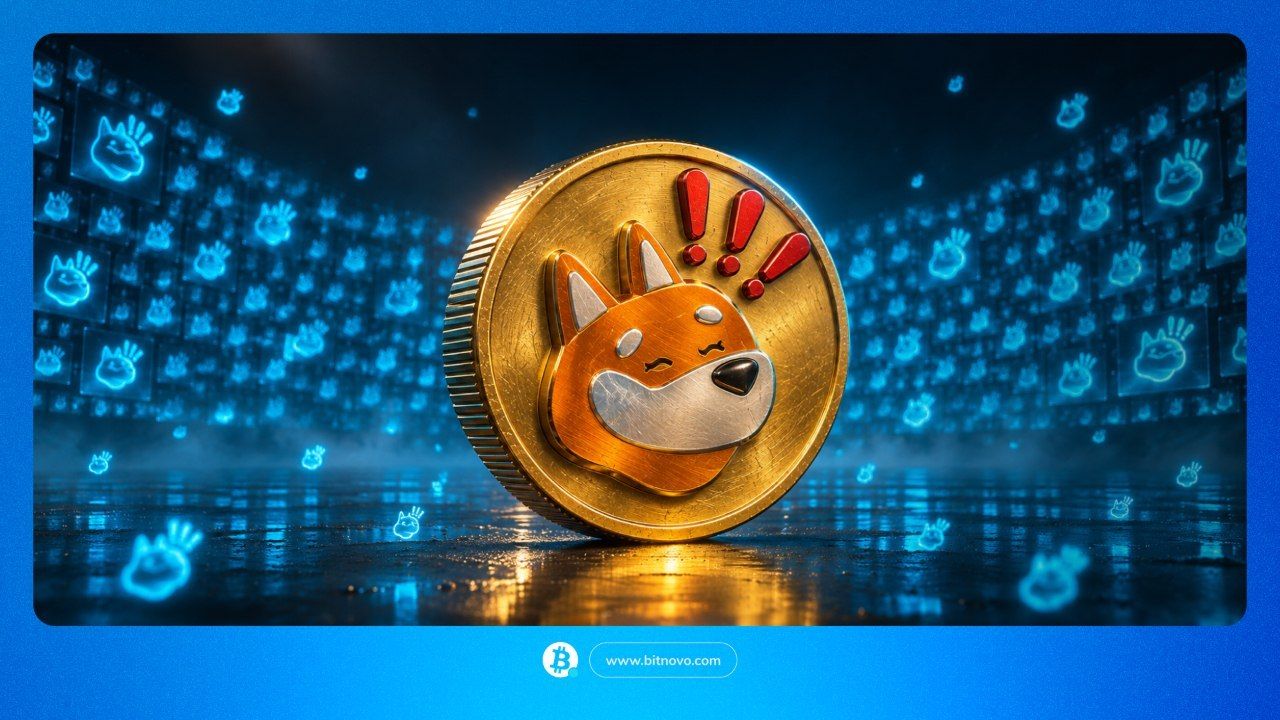
Bonk was born in December 2022, at the worst moment for the Solana network after the collapse of the FTX exchange, presenting itself as a Christmas gift designed to revitalize its community amid deep uncertainty.
With the value of SOL plummeting, the project achieved immediate visibility by distributing its tokens massively among active users and creators of the ecosystem, quickly becoming a symbol of community resilience that redefined interest in the network.
However, as happens with memecoins, it is a digital asset of extreme volatility and high risk of capital loss, so this information is purely educational and does not constitute financial advice or an investment recommendation.
What Bonk Is
Bonk (BONK) is a meme-type cryptocurrency based on the Solana blockchain that uses the figure of a Shiba Inu dog as its mascot and representative image. To understand its nature, it is key to remember that a memecoin is a token inspired by jokes, Internet characters, or cultural phenomena, whose initial value usually depends mainly on community enthusiasm and social media attention rather than a formal technological proposal.

How It Was Born: The Community Airdrop
The differentiating element of Bonk compared to other similar projects was its initial distribution strategy carried out on Christmas Day 2022. Citing data from CoinGecko, the official launch date of the token was December 25, 2022, when a massive airdrop was executed.
Unlike other launches that allocate a large part of the supply to venture capital funds or private sales, Bonk’s distribution was structured as follows:
- 50% for the community: Distributed directly among 50 trillion tokens to application developers, NFT collectors, artists, and Solana validators.
- 21% for early collaborators: Assigned to the project’s initial developers with a progressive three-year lock-up period.
- 16% for the DAO: Destined to Bonk’s decentralized autonomous organization to finance future initiatives and community projects.
This equitable distribution put the majority of the tokens in the hands of real users who were already interacting on the network, which clearly differentiated it from other memecoins and served as a morale boost for the ecosystem.
What Uses It Has Today
Although it began as a joke, the Solana community has been integrating the BONK token into different everyday tools within the network, without this meaning exaggerating its practical utility:
- Integration in dApps and games: It is used as a means of payment or reward in certain blockchain-based games and commerce platforms within Solana.
- Burn mechanisms: Tools associated with the ecosystem, such as trading bots on messaging platforms, allocate part of their fees to automatically buy and destroy BONK tokens, progressively reducing the circulating supply.
- Functions in DeFi and NFTs: It allows buying or trading digital assets and participating in simple decentralized finance activities such as providing liquidity.
Why Its Price Is So Volatile
The price of BONK experiences extreme fluctuations due to its own economic structure and the nature of the market. With a gigantic supply of tens of trillions of tokens, the price per unit is extremely small (fractions of a cent), which favors small variations in buy or sell volume generating very drastic percentage changes.
Likewise, its quotation depends heavily on the general activity of the Solana network and the media interest of the moment. This makes it especially vulnerable to market manipulation schemes known as pump and dump, where groups of speculators artificially drive up the price and then massively sell their positions, leaving losses for retail investors.
Risks of Memecoins
Investing or trading with meme-type tokens carries significant financial dangers that must be evaluated with caution:
- Total loss of capital: The value of these assets can quickly fall to zero if community interest disappears or if large holders decide to sell massively.
- Market manipulation and lack of backing: Lacking an underlying business or generating real cash flows, the price moves solely by speculation.
- Absence of institutional protection: Supervisory bodies such as the CNMV and the Bank of Spain constantly warn that this type of cryptoasset is not covered by investment guarantee funds nor does it have the usual customer protection schemes of the traditional banking system.
Truly, the analysis of the evolution of community tokens reflects how Internet culture can impact the dynamics of blockchain networks. Remember that memecoins are highly speculative assets and do not represent investment advice under any circumstances.

FAQ
- What is Bonk (BONK)? It is a community-oriented memecoin on Solana.
- When was Bonk created? It was launched on December 25, 2022, according to CoinGecko.
- How many Bonk exist? It has a total supply of 100 trillion tokens.
- Why is Bonk so volatile? Due to its enormous supply, low unit price, and high speculation.
- What is the difference between Bonk and other memecoins? Its initial airdrop prioritized real users over venture capital.