



Enjin was born in 2009 as a community platform for gamers, but its true transformation occurred in 2017 when it jumped into the blockchain ecosystem. With the vision of granting users real ownership of their digital assets within video games, the company went from being a social interaction space to becoming a key developer of decentralized infrastructure.
This change allowed the emergence of Enjin Coin (ENJ) and fundamental tools, such as the ERC-1155 standard, which have made it easier for studios to integrate tokenized economies efficiently. In this post, we will explain exactly what Enjin Coin is, the origin of its ecosystem, and the functionality of the platform that today positions itself as the reference for virtual goods in the crypto market.
What is Enjin? Where does it come from?
Enjin Coin (ENJ) is the currency designed specifically for the video game industry. Beyond being just a medium of exchange, ENJ has a key mission: to give you real ownership over your digital assets. Thanks to smart contracts on the Ethereum network, the platform facilitates secure transactions between players and allows items to be interoperable, meaning they can work across different games.
Furthermore, the token serves a vital technical function: it is used to create NFTs. Every time a developer creates a new digital asset, they use ENJ as a means of payment, turning this token into the central piece that gives value and utility to everything generated on the platform.
Where does it come from?
It all began in 2009 in Singapore, when Maxim Blagov and Witek Radomski founded the company originally as a community platform for gamers. For nearly a decade, they focused on connecting clans and communities, reaching 20 million users before making the big leap.
The turning point came in 2017: after a successful initial coin offering (ICO) that raised almost $19 million, the team decided to pivot towards blockchain technology. It was then that they launched their own ecosystem on the Ethereum mainnet in 2018.
Thanks to this approach, Enjin not only survived the transition to Web3 but also consolidated itself as a key piece in the sector’s infrastructure. After surpassing the barrier of 1 billion digital assets created years ago, the ecosystem has continued to evolve: in 2023 it completed its migration to its own native blockchain based on Substrate, and today, in 2026, it remains a benchmark thanks to constant technical updates and developer tools.
What is the ENJ token and how does it work
ENJ is a token under the ERC-20 standard that operates on the Ethereum network, with a maximum supply limited to 1 billion units. Its main function goes far beyond being a simple medium of exchange: it acts as a reserve asset.
Every time an NFT is created within the platform, an amount of ENJ becomes «locked» inside that digital object. Thanks to this, each item you own in a game acquires a real and verifiable backing value.
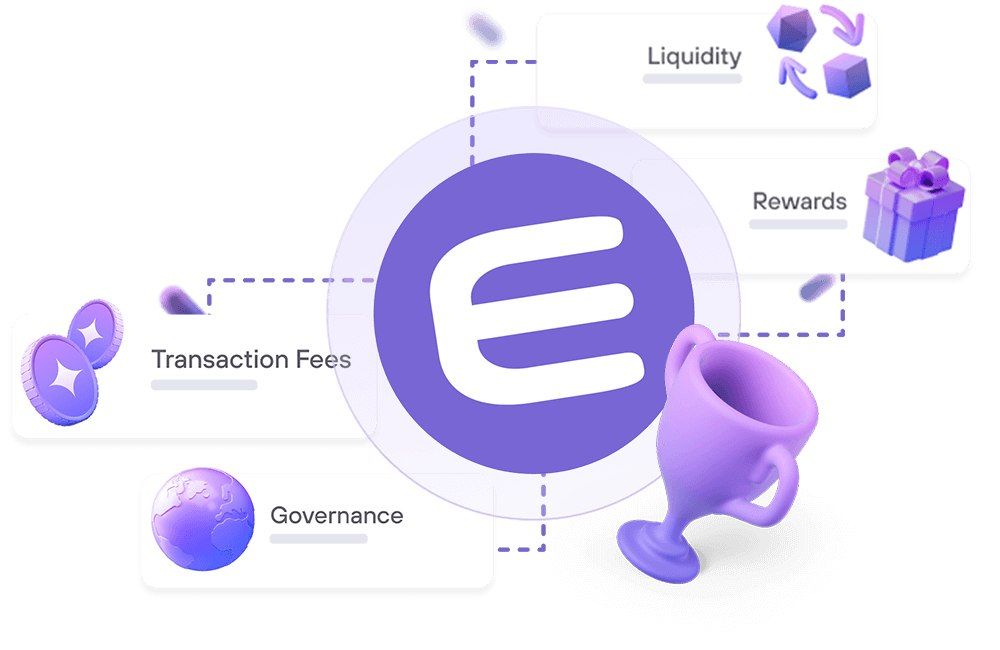
In addition to giving this intrinsic value to your objects, ENJ is the engine that drives the entire ecosystem: it is used to pay network fees, participate in governance decisions, and facilitate secure exchange on platforms like NFT.io.
Minting and melting: how ENJ enters and exits
To understand the movement of the token, imagine a simple cycle of entry and exit:
- Minting:When a developer designs a new virtual object, they must lock an amount of ENJ inside the NFT. At that moment, that ENJ leaves general circulation and becomes tied to the asset.
- Melting: If you decide you no longer want an object, you can «melt» it. By doing so, the NFT disappears, but the ENJ that was locked inside returns to your wallet.
It is a balance dynamic: the more unique items are created in games, the more ENJ is withdrawn from active circulation, ensuring that your virtual goods always maintain a tangible backing value.
The tools of the Enjin ecosystem
The Enjin ecosystem is supported by a series of tools designed to simplify interaction with blockchain technology, both for gamers looking to manage their assets and for developers wanting to integrate these elements into their projects.

|
Tool |
What is it? |
What is it for? |
| Enjin Wallet | Own digital wallet. | Store, manage and melt digital assets (ERC-1155) without technical complications. |
| Enjin marketplace | Decentralized marketplace. | Buy and sell tokenized objects using ENJ as a means of payment. |
| JumpNet | Proof of Authority (PoA) blockchain. | Facilitate NFT transactions without incurring gas costs. |
| Efinity | Scaling solution on Polkadot. | Enable high-volume transaction processing efficiently. |
| SDKs and APIs | Development kits and connection tools. | Integrate blockchain functions into engines like Unity or Godot without building your own infrastructure. |
What is the utility of Enjin Coin
ENJ is not just a coin; it is the tool that allows virtual worlds to have a real economy. Its utility is based on practical and verifiable applications within its ecosystem:
- Minting:Allows developers to create NFTs, giving them life and value by «locking» ENJ inside each object.
- Trading: It is the standard medium of exchange in the official marketplace, where players buy and sell their assets.
- Melting: If a player wishes, they can destroy the virtual object to recover the ENJ that backed it, turning digital assets into liquid value.
- Real integration: A historical and verified example was EnjinCraft, a plugin that allowed Minecraft server owners to integrate a blockchain-based economy, linking in-game objects with the Enjin wallet.
Like any crypto asset, ENJ carries inherent risk. Its value and adoption depend on the dynamics of a volatile market and the project’s ability to remain relevant in the face of increasing competition.