


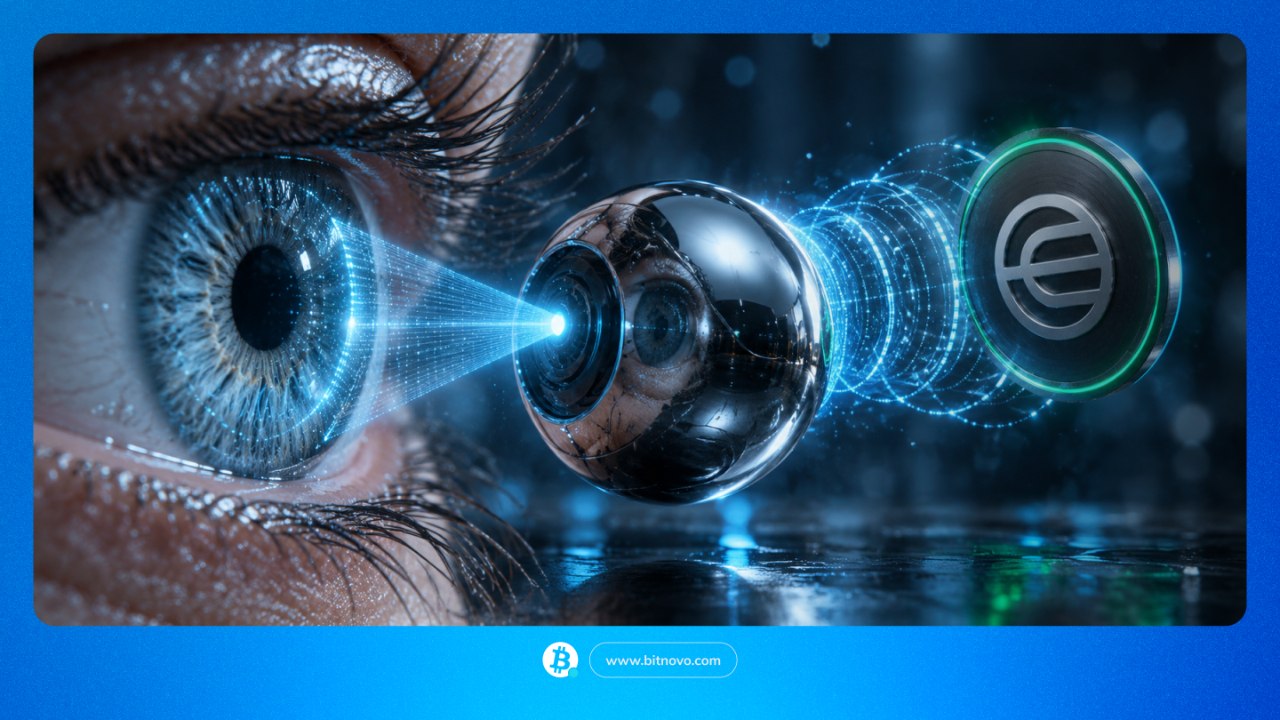
A visual phenomenon flooded cities around the world: lines of people waiting in front of a metallic orb with a futuristic design to scan their eyes in exchange for cryptocurrencies. What for some seemed like a science fiction scene and for others a quick income opportunity, represented the calling card of Worldcoin (today rebranded simply as World).
A project co-founded by Sam Altman, CEO of OpenAI, this initiative was born with a monumental purpose: to create the largest identity and financial network on the planet in the era of artificial intelligence.
To understand this phenomenon without getting lost in enthusiasm or panic, it is necessary to go beyond the anecdote of the scan. In this article you will discover what is really behind the Orb, how the technology that verifies your identity without revealing your name works, and what the ethical and privacy implications are of handing over a biometric data point as unique and irreplaceable as the iris.
What World Is
In line with this vision, the project took a fundamental strategic turn. On October 17, 2024, the initiative formally announced its name change: Worldcoin became simply World. This decision responded to a two-year evolution to stop presenting itself solely as a cryptocurrency and consolidate itself as a global identity network that also includes a native token (WLD).
Therefore, to understand the project it is necessary to differentiate its components:
- World ID: It is a digital passport that allows proving that one is a real and unique human without revealing the person’s name or identity.
- WLD Token: It is the network’s cryptocurrency, used as a distribution and exchange incentive.
Who Is Behind It: Sam Altman and Tools for Humanity
To deduce how this proposal arose, it is necessary to look at its creators. The project was conceived in 2019 with an anticipated vision: as artificial intelligence became more advanced and indistinguishable from human activity, the digital world would require an infallible way to separate real people from machines.
Now then, behind the initiative are three key figures: Sam Altman (renowned CEO of OpenAI and public figure after ChatGPT), Alex Blania, and Max Novendstern.
However, Sam Altman’s role stands out particularly. His dual role, as leader of the most influential artificial intelligence company on the market and, at the same time, co-founder of a system designed to protect the world from the excesses of AI, generates both interest and ethical debate.
On the other hand, the practical and operational development of the project does not fall directly on the World foundation, but on Tools for Humanity (TFH) . Led by Alex Blania as CEO, this technology company is responsible for:
- Designing and manufacturing the physical devices (Orb).
- Developing the official application (World App).
- Building the network infrastructure (World Chain).
Likewise, this deployment has solid financial backing. Tools for Humanity has managed to raise more than $250 million from high-profile investment firms in Silicon Valley and the crypto sector, such as Andreessen Horowitz (a16z), Khosla Ventures, and Blockchain Capital.
How It Works
Starting from this structure, the ecosystem operates through a fluid interaction between hardware, software, and cryptography. The nerve center of the process is the Orb, the well-known spherical device responsible for physical verification.

Through the World App application, the user generates a pair of cryptographic keys and goes to an Orb to scan their iris. The system converts the biometric image into an IrisCode. Using advanced multiparty computation techniques, the original image is deleted and the encrypted code is fragmented across different servers, guaranteeing privacy by design and preventing duplicate registrations on the network.
The Orb and Iris Scanning
Consequently, the Orb acts as the physical access door to the system. Its function is to verify that the person in front of the camera is a real and unrepeatable human being.
This method differentiates World from other blockchain projects, as it uses biometrics as an anti-fraud filter. By validating the eye, the Orb confirms that the user has not registered before and does not store personal data or real names in the process.
World ID: The Proof That You Are Human
Once verification is completed, the user obtains their World ID, a digital passport that works as a Proof of Humanity.

This system allows people to identify themselves to third-party platforms without revealing who they are. To protect anonymity with each use, the network employs technologies such as single-use nullifiers and distributed proof networks, preventing digital interactions from being traced or linked to each other. To date, nearly 18 million people in 160 countries have verified their identity through this mechanism.
The WLD Token
Finally, validation allows the user to claim the WLD token, the ecosystem’s native cryptocurrency.
- Technical standard: It is an ERC-20 token issued on the Ethereum mainnet, although user rewards are distributed on the Optimism layer 2 network.
- Initial supply: It has a limit set at 10 billion tokens for its first 15 years.
- Distribution: 75% is destined for the community (users, ecosystem fund, and operations), 13.5% for initial investors, about 10% for the founding team, and 1.7% is kept as a reserve.
What It Claims to Be For
Based on this identity and financial distribution infrastructure, World’s creators base their proposal on two major promises oriented toward the future of the digital and socioeconomic environment:

- Distinguishing humans from AI bots: Given the proliferation of generative artificial intelligence, the project maintains that its World ID will serve as an essential filter to restore trust on the Internet. The goal is to prevent spam, limit the creation of fake accounts on social networks, prevent manipulation in digital voting, and authenticate online interactions without sacrificing anonymity.
- Infrastructure for a Universal Basic Income (UBI): The most radical ambition raised by the team is to lay the technological foundations for an eventual Universal Basic Income. Under this vision, as AI automates millions of jobs and generates economic abundance, World’s network would allow digital funds to be periodically distributed to every verified person on the planet equitably and free of fraud.
It is essential to emphasize that these applications represent the project’s conceptual and aspirational proposal, not guaranteed facts or realities fully consolidated in the present.
Privacy: Why It Worries Regulators
Beyond innovation and advances, the true bottleneck for World is not technology, but international legislation. Mass iris scanning in dozens of countries collided head-on with global data protection regulations, unleashing a wave of suspensions, sanctions, and administrative investigations.

Although the project assures that the original images are processed locally in the Orb and converted into encrypted and anonymous algorithms, privacy agencies insist on a key principle: a biometric data point is unique, permanent, and irreplaceable. Losing or exposing a password allows it to be changed; losing the digital signature of your eyes is an irreversible risk.
What the AEPD Did in Spain
The brake in Europe began forcefully in the Spanish market. On March 6, 2024, the Spanish Data Protection Agency (AEPD) ordered the precautionary and immediate suspension of the collection and processing of personal data by Tools for Humanity in the country, also blocking the use of the information collected up to that date.
The AEPD justified this exceptional measure under article 66.1 of the General Data Protection Regulation (GDPR) after receiving multiple complaints about:
- Insufficient and misleading information to the user.
- Collection of biometric data from minors.
- Technical and practical impossibility of withdrawing previously granted consent.
Subsequently, Tools for Humanity assumed the voluntary commitment not to resume its scanning operations in Spanish territory until the Bavarian Data Protection Authority (BayLDA) concludes the ongoing investigation.
What Other Countries Have Done
The Spanish ruling triggered a regulatory “domino effect” on a global scale. Various oversight bodies have intervened, arguing privacy violations, lack of transparency, or aggressive practices in attracting users in lower-resource areas.
|
Country |
Date | Action taken |
Official regulatory authority |
| Portugal | March 2024 | Temporary suspension of operations | CNPD (Comissão Nacional de Proteção de Dados) |
| Hong Kong | May 2024 | Order to cease operations for violating privacy | PCPD (Privacy Commissioner for Personal Data) |
| South Korea | September 2024 | Fine of 1.1 billion KRW | PIPC (Personal Information Protection Commission) |
| Germany | December 2024 | Order to comply with GDPR and delete data | BayLDA (Bayerisches Landesamt für Datenschutzaufsicht) |
| Brazil | January 2025 | Total prohibition under penalty of daily fine | ANPD (Autoridade Nacional de Proteção de Dados) |
| Indonesia | May 2025 | Revocation and suspension of operating permits | Komdigi (Ministry of Communication and Digital) |
| Kenya | 2023–2025 | Precautionary suspension and judicial order for deletion | ODPC (Office of the Data Protection Commissioner) |
What to Think Before Scanning Your Iris
Before going to an Orb, it is vital to understand the impact of handing over your biological information:
- A biometric data point is not replaceable: If your passwords are compromised, it is enough to change them. If a mathematical representation of your retina is exposed, you cannot replace your eyes.
- Privacy rights in practice: The law guarantees rights such as access and deletion of data. However, deleting records processed on cryptographic and fragmented networks presents significant technical complexities.
Frequently Asked Questions About Worldcoin
- Is World the same as Worldcoin? World is the global identity and digital network ecosystem, while Worldcoin (WLD) is the cryptographic token used as the platform’s incentive.
- Is Worldcoin legal in Spain? Currently its devices are not operational. The AEPD blocked data collection and the company keeps the Orbs suspended after the regulator’s warnings while data protection aspects are reviewed.
- What happens to the image of my iris? The Orb processes the capture in its local memory to generate an IrisCode and deletes the original image immediately.
- Can I request that my data be deleted? You can request the deletion of your account and associated data directly from the World App or through its support channels.
Truly, World proposes a cutting-edge model that seeks to authenticate human identity against artificial intelligence. However, handing over unique biometric data requires weighing privacy risks. Before giving up a permanent biological credential, the key lies in being fully informed about its use and protection.