



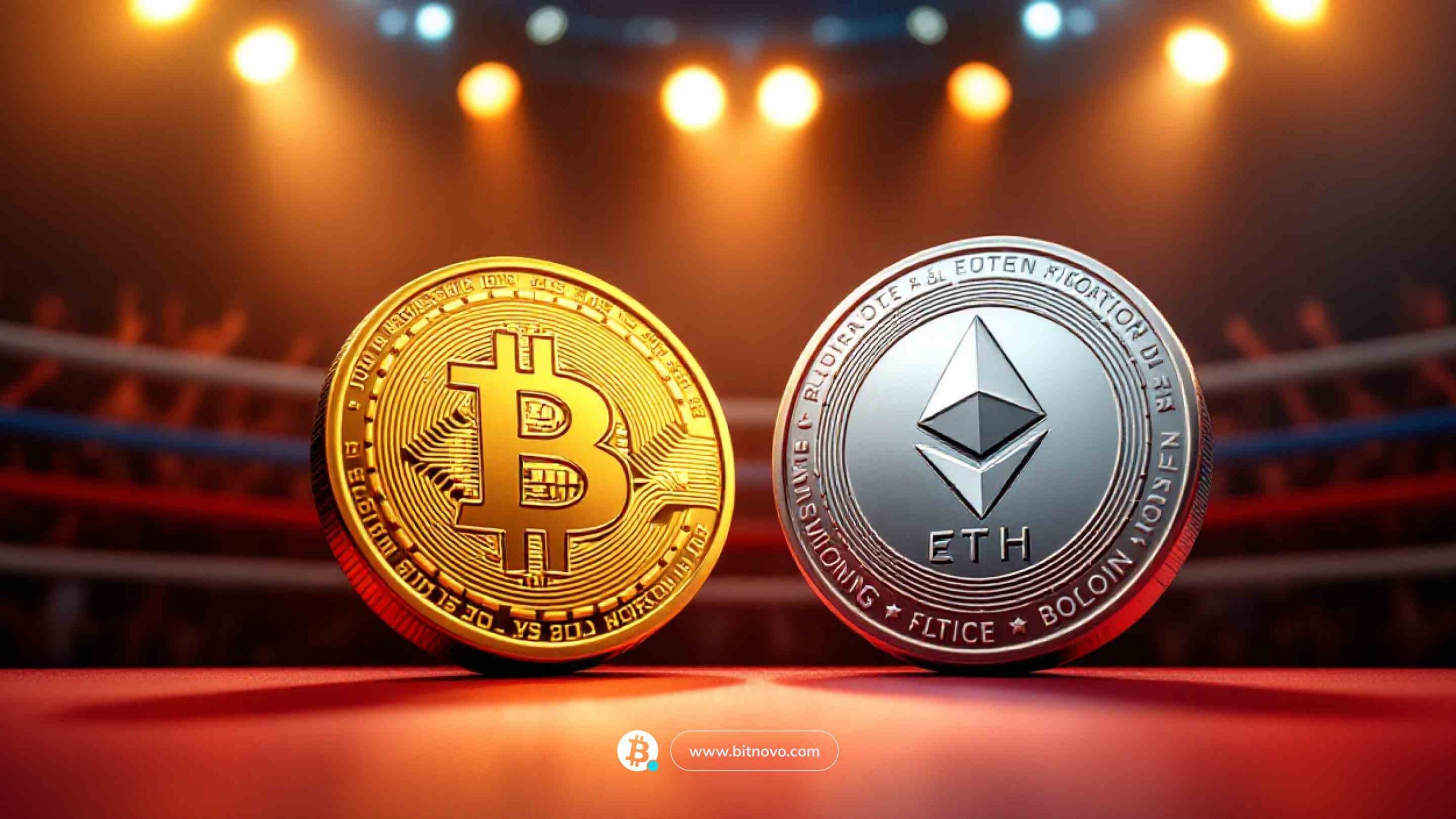
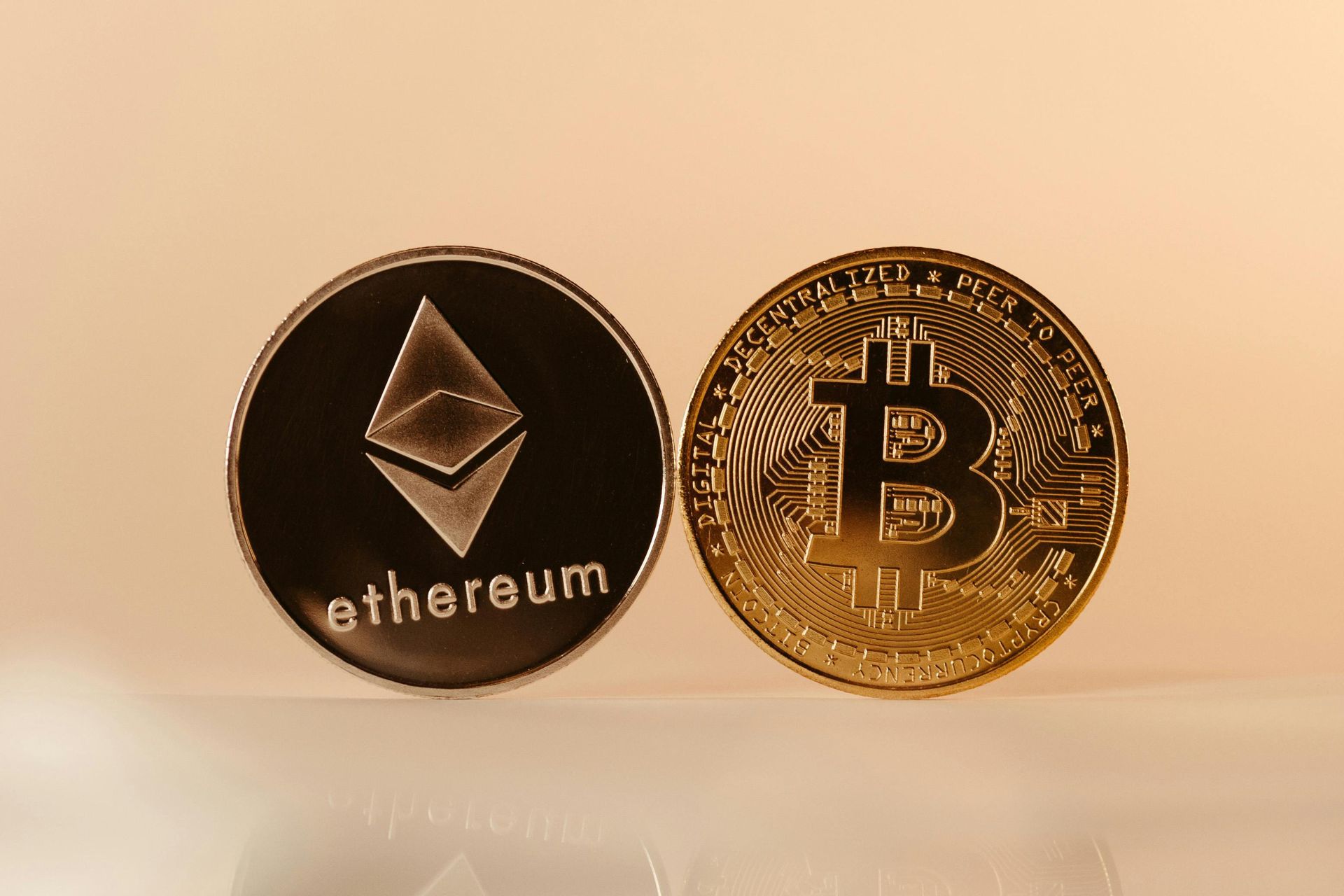
Bitcoin (BTC) or Ethereum (ETH)? This is the million-euro question…And the answer is crucial, because they are not interchangeable assets. While both dominate the crypto market by capitalization, their fundamental purposes are completely different.
Bitcoin has established itself as “digital gold,” a decentralized store of value and a hedge against inflation. Ethereum, on the other hand, is the “world computer,” the indispensable platform that gives life to decentralized finance (DeFi), NFTs, and Web3.
In this guide, we break down their differences concisely. In the end, you will know exactly which one suits your needs and if your goal is long-term accumulation or active participation in the new digital economy.

What is Bitcoin? The digital gold
Daily, this word appears linked to record figures, billionaires, and the promise of a financial future. However, beyond the flashy headlines and volatile price, there is brilliant technology and a revolutionary economic concept. If you have felt left out of the conversation or that the jargon is too complicated, this is the perfect place so you can share it with anyone.
So, Bitcoin is the first cryptocurrency that appeared. It is a decentralized digital currency that enables a new payment system and digital asset. Although it is increasingly used, there are still many users who do not know what it is for and what its advantages and risks are.
What is the origin of Bitcoin?
Bitcoin was born in November 2008, when a person (or group of people) under the pseudonym Satoshi Nakamoto, sent a message to a cryptography mailing list, describing a project to create a digital currency that would serve to account for and transfer value.
As Nakamoto himself stated when this cryptocurrency emerged: “Bitcoin is born with high ambitions: to provide citizens with a means of payment that enables fast, low-cost value transfers, and that, furthermore, cannot be controlled or manipulated by governments, central banks, or financial entities.”
Now, in January 2009, the first network based on the Bitcoin protocol went live, which marked the origin of cryptocurrencies. Starting in 2011, some organizations began accepting donations in bitcoins and merchants operating on the Internet began accepting these currencies as a means of payment.
From that moment on, its growth was unstoppable. However, over these years, more new cryptocurrencies have emerged, competing with Bitcoin and causing its value to fluctuate constantly.
Main characteristics
One of the reasons why Bitcoin has attracted so much attention is because of the advantages it offers compared to traditional money.
- Limited supply.Unlike traditional currencies that governments can print without limit, there will only ever be 21 million bitcoins. This makes it resistant to inflation. Once that number is reached, no more can be created.
- Store of value.Bitcoin is considered by many as “digital gold” due to being resistant to censorship and to confiscation or centralized control.
- Predictable monetary policy.Its issuance rate is periodically reduced (through an event called halving), making its monetary policy transparent and not subject to arbitrary decisions by a central authority.
- Proof of Work (PoW).This is an essential characteristic of Bitcoin because it solves the double-spending problem in a decentralized digital environment, making it fundamental for Bitcoin to function as a form of digital money.
- Simplicity and security.Bitcoin transactions are potentially secure and hard to forge thanks to Blockchain technology, although this does not mean the user is not vulnerable to cyberattacks.
- No intermediaries.When you use Bitcoin, you don’t need banks or payment platforms. This makes it faster and more economical, especially for international transfers. Want to send $1000 to Costa Rica? With Bitcoin you can do it in minutes.

Main use case
Bitcoin’s main use case has solidified as:
- Store of value.This is its predominant function. Due to its limited supply of 21 million and its decentralized design, it is seen as an asset that maintains its purchasing power in the long term. It functions as a hedge against inflation and the devaluation of fiat currencies, since its issuance cannot be altered by any central entity.
- Global value transfer system.It allows settling large amounts of value internationally without depending on traditional banks or intermediaries, making it a permissionless and censorship-resistant transfer system available 24/7.
In summary, Bitcoin has changed the way we think about money and finance. It is primarily used as a sovereign digital savings and as a borderless global settlement rail. By the way, with Bitnovo you can buy Bitcoin securely and store it in your own wallet, having full control of your keys.
What is Ethereum?
Ethereum is the second largest cryptocurrency by market capitalization, after Bitcoin. It is also a decentralized computing platform that can run a wide variety of applications.
Indeed, Ethereum is not just a cryptocurrency. It is a digital platform based on blockchain technology that allows other people to create applications, contracts, and services in a decentralized way. Its native cryptocurrency is called Ether (ETH).
What is the origin of Ethereum?
The history of Ethereum begins in 2013, when the young programming genius Vitalik Buterin proposed expanding the capabilities of Bitcoin, limited to finance, to create a platform that would allow developing decentralized applications (DApps).
After his idea was rejected by the Bitcoin team, Buterin joined other co-founders, Gavin Wood, Mihai Alisie, Amir Chetrit, Jeffrey Wilke, Joseph Lubin, Charles Hoskinson and Anthony Di Iorio to materialize the project. After gaining notoriety at a conference in 2014, the team launched an Initial Coin Offering (ICO) that same year, raising over $18 million. This enabled the official launch of the network in July 2015, initially under the name “Frontier.”
In essence: Ethereum was born from Buterin’s vision of turning blockchain technology into a programmable “world computer” for much more than just money transfers.
“When I came up with Ethereum, my first thought was: Well, this is too good to be true. It turned out that Ethereum’s core idea was good, fundamentally, completely solid.” Vitalik Buterin.
Main characteristics
Ethereum represents the evolution of the blockchain concept, moving from being a simple digital currency to becoming a decentralized and programmable platform. The core characteristics that define Ethereum as the “world computer” revolve around its ability to execute Smart Contracts and its innovative architecture, anchored in its ETH token and, crucially, in its current Proof of Stake (PoS) mechanism since 2022.
- Anyone with internet access can use Ethereum, making it accessible to people in countries with limited banking systems.
- The decentralized nature of Ethereum and its use of advanced cryptography make transactions and applications potentially secure, although this does not mean the user is not vulnerable to cyberattacks.
- Both in Europe and the United States, crypto service providers follow regulations that prevent illicit uses of the cryptocurrency.
- The price of Ethereum can fluctuate significantly over short periods of time.
- Ethereum allows the creation of a wide variety of decentralized applications, making it versatile.
- The transition to PoS and successive improvements have opened the door to network scalability, but especially the use of so-called Layer 2 networks, which use Ethereum as the source of truth to record the evidence of their transactions, have allowed the Ethereum ecosystem to grow considerably.
- Technical complexity.The creation and management of Smart Contracts and dApps can be complex and requires advanced technical knowledge.
- Smart Contracts.Ethereum allows the creation of Smart Contracts, which are programs that execute automatically when certain predefined conditions are met.

Main use case
- DeFi applications.You can request loans, earn interest on your savings, or exchange cryptocurrencies, all without going through a bank. You always have control of your money.
- Decentralized applications (dApps).Ethereum enables the creation of dApps, which are applications that run on the Blockchain and do not depend on centralized servers.
- You’ve surely heard about digital artworks or collectibles sold for thousands of dollars. Ethereum is the favorite network for creating these NFTs, as it allows verifying ownership uniquely and securely.
- Gaming and virtual worlds.On platforms like Decentraland, you can buy digital land or build your own virtual business, and all of this runs on Ethereum.
- Data protection.You can create digital identities and share only the necessary information without compromising all your privacy.
- Ethereum allows sending money anywhere in the world quickly.
- Smart Contracts.They enable the automation of agreements and transactions, reducing the need for intermediaries and increasing efficiency.
Today, a huge number of applications run on the Ethereum Blockchain, from financial tools and games to complex databases. Furthermore, its future potential is only limited by the imagination of developers. In the words of the non-profit Ethereum Foundation: “Ethereum can be used to code, decentralize, secure, and trade almost anything.”
Key differences between Bitcoin and Ethereum
Within the cryptocurrency sector, Bitcoin and Ethereum remain the two best-known and highest-capitalization currencies. While it is true that both share certain common characteristics, in the sense that both are based on blockchain and can be exchanged and traded among users, there are important differences between them that are worth knowing.
The most fundamental difference lies in their vision: Bitcoin is a currency that prioritizes scarcity and security to be a reserve asset. Ethereum is a platform that prioritizes functionality and programming to build the decentralized Internet.
|
CHARACTERISTIC |
₿ BITCOIN |
♦ ETHEREUM |
| Year of creation | 2009 | 2015 |
| Creator | Satoshi Nakamoto | Vitalik Buterin |
| Native currency | BTC | ETH |
| Total supply | Strictly limited to 21 million BTC | No strict limit, but is deflationary under PoS due to fee burning (EIP-1559) |
| Main purpose | Digital money | Platform for smart contracts |
| Consensus | Proof of Work (PoW) | Proof of Stake (PoS) |
| Block time | ~10 minutes | ~12 seconds |
| Energy consumption | High Low | (95% reduction after The Merge) |
| Programming language | Bitcoin Script (limited) | Solidity (Turing complete) |
| Use cases | Payments, store of value | DeFi, NFT, dApps, contracts |
Advantages and disadvantages
|
₿ BITCOIN |
♦ ETHEREUM |
|
| Advantages | Not controlled by any government, bank, or company
Greater adoption and recognition Maximum security and decentralization Limited and predictable supply Use it for daily expenses and online payments Send it instantly anywhere in the world Long-term investment |
Accessibility to the dApp ecosystem
Versatile Smart Contracts DeFi and NFT ecosystem Constant innovation Faster transactions Lower energy consumption |
| Disadvantages | Limited transaction speed
Volatility Payments are irreversible Not universally accepted as a payment method Energy consumption |
Price volatility
Transaction costs are increasing Greater technical complexity Variable and sometimes high gas fees Vulnerabilities in Smart Contracts No supply limit |
Real use cases
The use cases for cryptocurrencies are diverse and evolving rapidly. From fast money transfers to Smart Contract platforms, and from utility tokens to tokenized assets, these use cases are demonstrating applications once thought impossible.

In general, cryptocurrencies continue to mature and integrate into everyday finances. Governments and companies are exploring digital currency initiatives, while innovators build new products on Smart Contract platforms.
When to use Bitcoin?
|
Real use case |
Description |
Main reason |
| Long-term investment (HODL) | Long-term investment (HODL) Holding Bitcoin for years as a savings and wealth accumulation strategy. | Programmed scarcity (21M): Acts as a deflationary asset against the unlimited printing of fiat currency. |
| Large global transfers | Moving large amounts of value across borders quickly and efficiently. | Decentralization and speed: Avoids the high costs, delays, and restrictions of traditional banking and remittance systems. |
| Protection against inflation | Using Bitcoin as a “safe haven” asset in countries with high inflation or economic instability. | Censorship resistance: No one can confiscate or devalue it centrally, preserving purchasing power. |
| Banking alternative | Serving as a personal bank account for those without access to the traditional financial system. | Permissionless access: Only a smartphone and internet are needed; eliminates the need for intermediaries or complex identification requirements. |
| Juan needs to send €10,000 to his family in Mexico. With Bitcoin he can do it in minutes with minimal fees vs 3-5 days and 5-8% fees with Western Union. | ||
When to use Ethereum?
|
Real use case |
Description |
Main reason |
| Buy/Create NFT | Acquiring or issuing NFTs representing art, music, collectibles, or digital identity. | ERC-721 and ERC-1155 standards: Ethereum pioneered the token standards that guarantee verifiable and unique ownership of digital assets. |
| Participate in DeFi | Using Decentralized Finance applications (DApps) for loans, staking, insurance, or token exchange. | Composability and EVM: The Ethereum Virtual Machine allows Smart Contracts to interact freely, creating an open and permissionless financial ecosystem. |
| Blockchain Gaming | Gaming where assets are owned by the player (Play-to-Earn or Play-and-Earn model). | Ownership integration: Allows in-game items to be transferable and sellable NFTs outside the game environment. |
| Smart Contracts | Automating legal or business agreements that execute automatically when predefined conditions are met. | Immutable execution: The contract code executes exactly as programmed, eliminating the need to trust intermediaries. |
| María is a digital artist and sells her works as NFTs on OpenSea (which runs on Ethereum), earning automatic royalties on every resale. | ||
How to buy Bitcoin and Ethereum with Bitnovo?
Bitnovo is a Spanish company founded in 2015 by Marcos Muñoz, with its headquarters in Valencia, Spain. Since its beginnings as a platform for buying and selling bitcoins, the company has diversified its catalog and adopted new technologies to remain relevant in the dynamic crypto world.
Yes indeed, Bitnovo allows you to buy Bitcoin in a matter of minutes, without cumbersome registrations and with multiple payment methods. If you want to buy with Bitnovo you just have to find the way you like best, but in a secure, fast, and simple way:
1. Register on Bitnovo
Create your account from the App, available on Android and iOS. You can also operate from the website. Your registration is unique and will serve you to operate from any device.
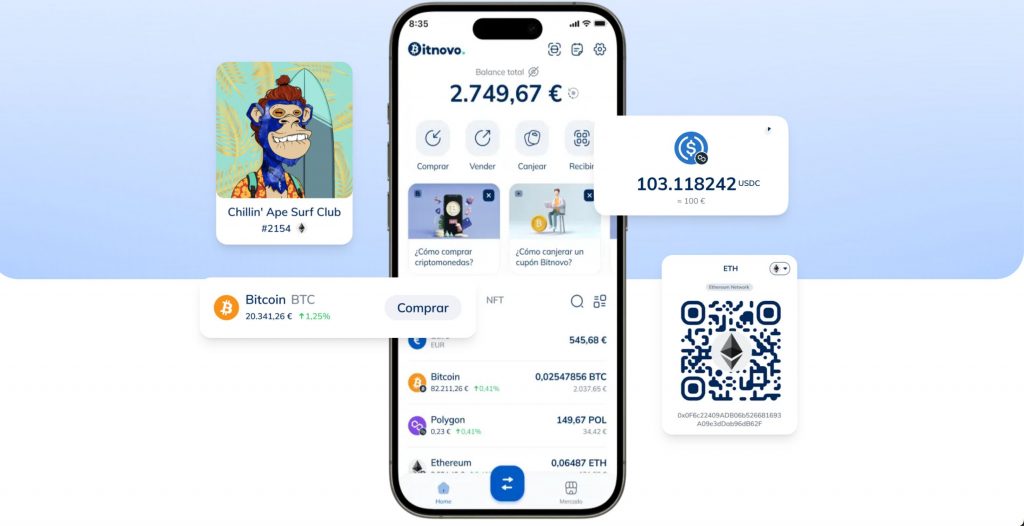
Once your account is created, to be able to operate, you will need to validate your identity quickly thanks to an optimized process.
2. Redeem a coupon or buy directly
Make your payment via the method you prefer: bank transfer, card, or in cash with coupons redeemable for cryptocurrencies, available at over 40,000 points of sale. Once the purchase is completed, your crypto will be deposited into your wallet quickly and securely.
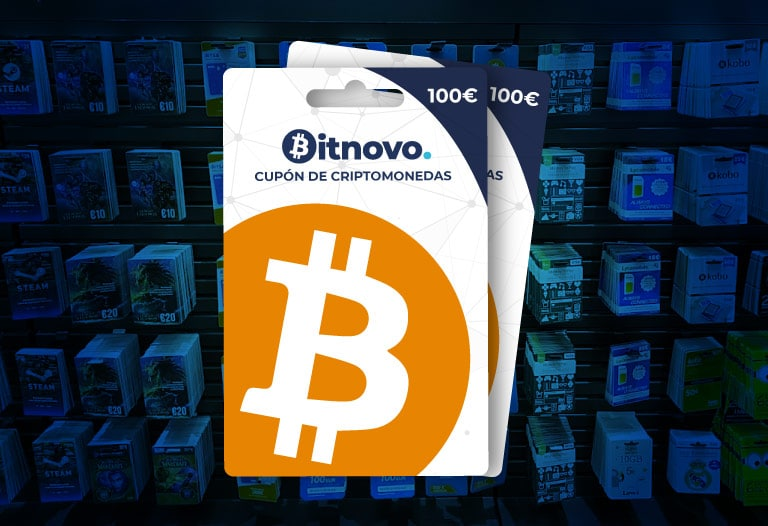
By the way, buying Bitcoin in cash at physical stores is the latest trend in the crypto world and Bitnovo offers it to you. Our recommendation is that you buy in stores that can provide you with guarantees.
3. Receive your BTC or ETH in your wallet
After payment, you will receive your crypto in your wallet, without intermediaries or delays. Your keys, your crypto!
Very important, Bitnovo has a team ready to help you and resolve any queries 24 hours a day, every day of the week! The conveniences just keep increasing! And this is just the beginning.
Do you already have your first cryptocurrencies? If not, it’s never too late to start exploring the fascinating crypto world! Who knows, maybe you are part of the next great financial revolution! Or as Alexis Ohanian says: “It’s not about buying Bitcoin, it’s about participating in the future of currency and technology.”