



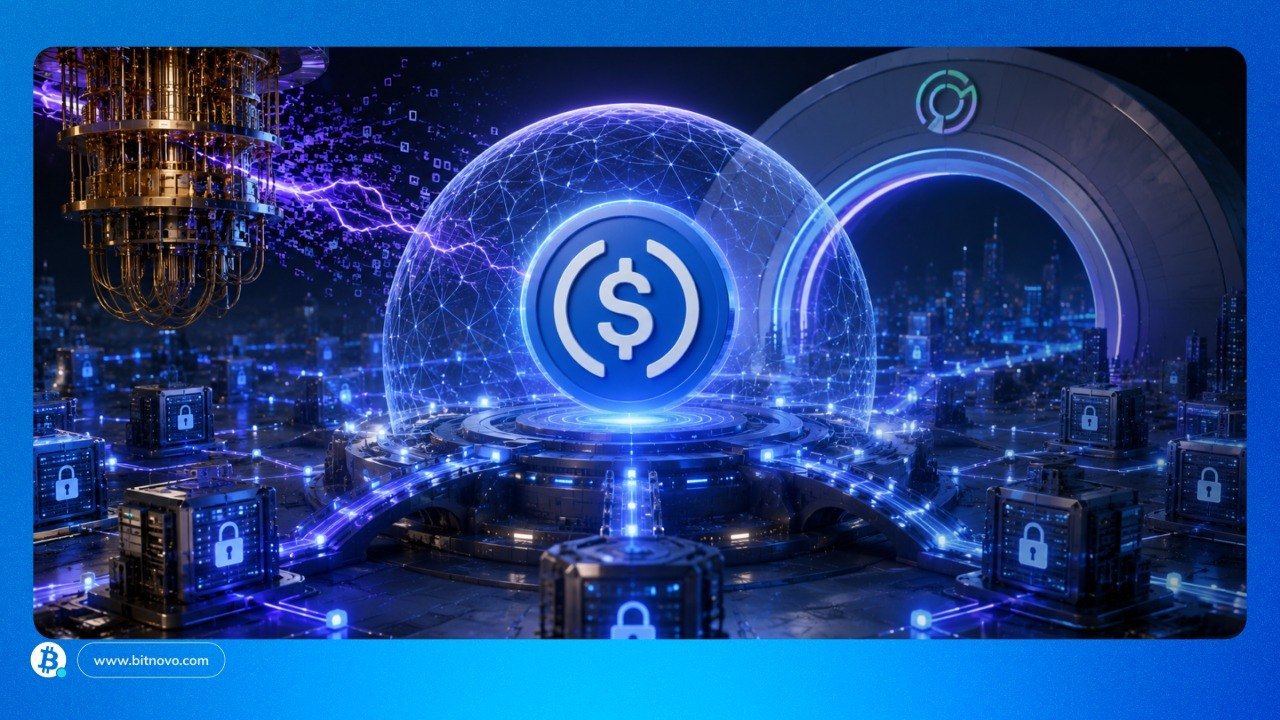
Current cryptocurrencies are protected with encryption systems that today’s computers cannot break. However, future quantum computers could indeed put them in check. Circle knows this and has designed its new blockchain, Arc, to resist this threat from day one.
Circle, widely known in the crypto ecosystem as the company behind the famous stablecoin USD Coin (USDC), has made a monumental strategic leap. The company has officially launched Arc, its own Layer 1 blockchain network (a native, independent infrastructure) designed specifically for the management of USDC and other stablecoins.
This move goes far beyond launching a new product; it is about building the financial highways that will sustain the future of digital money at an institutional level. If today many users seek to buy USDT or USDC to protect their capital, Circle wants the ecosystem where these assets move to be the safest in the world.
Circle and its new blockchain Arc
Circle has decided to make a historic leap by creating its own infrastructure: Arc, an independent Layer 1 blockchain. Unlike traditional networks, Arc is designed specifically for institutional and financial use, using USDC itself to pay gas fees, avoiding the need to use volatile cryptocurrencies.
The project launched its testnet version in October 2025 and, after a successful presale that raised $222 million, is preparing to launch its mainnet in the summer of 2026.
Introducing Arc, the home for stablecoin finance.@Arc is an open Layer-1 blockchain purpose-built to drive the next chapter of financial innovation powered by stablecoins.
Designed to provide an enterprise-grade foundation for payments, FX, and capital markets, Arc delivers… pic.twitter.com/Z8FHUls1xY
— Circle (@circle) August 12, 2025
What is Circle Arc and why is it different?
Circle Arc is an «Economic Operating System» developed for instant settlement of stablecoins and tokenized finance.
The vision of Jeremy Allaire, CEO of Circle, is very clear: Arc was not born to compete in speed with networks like Solana, nor to be another version of Ethereum. Its sole objective is to «operate the real economy» under a «regulation first» approach, safely attracting capital from traditional banking and Wall Street.

How crypto wallet security works today
To understand Arc’s great achievement, we must first look at how we protect our digital money today. Imagine that your wallet is a digital safe and your private key is a unique, secret handwritten signature.
When you decide to send funds to store in your wallet, every transaction you make requires your mandatory authorization. The process works very simply:
- The order:You enter the amount and the destination address.
- The signature: When you press «send», your wallet automatically stamps that cryptographic digital signature on the operation.
- Verification: The network verifies it to approve the sending.
Breaking this process with current technology is impossible: a traditional computer would take thousands of years to guess your signature. That is why your assets are completely secure today.
The coming threat: quantum computing
The problem is that future quantum computers will have radically different computing power. Such a machine could decipher that digital signature in seconds. And in the blockchain world, if someone duplicates your signature, they have irreversible control over all your funds.
Quantum computing introduces long-term risk for digital infrastructure, from wallet signatures to validator integrity and more.
Circle’s post-quantum whitepaper explores Arc’s phased approach to resilience across:
→ USDC
→ Smart contracts
→ Validators
→ Infrastructure… pic.twitter.com/niZqxTnUvX— Arc (@arc) May 29, 2026
Although there is no concrete date for when this will become a real danger, the risk already exists today under the «harvest now, decrypt later» strategy. This means that malicious actors could already be recording and storing today’s encrypted transactions to decrypt them in the future, when they have access to a powerful quantum computer. Therefore, protection cannot wait.
To neutralize this danger before it happens, Circle has designed Arc with a state-of-the-art quantum shield. From the launch of its mainnet this same 2026, the blockchain will allow the use of wallets equipped with post-quantum signature algorithms.
By implementing this barrier, Arc ensures that only you can authorize your transfers, keeping your digital money ownership intact against upcoming technological advances.
What Arc does differently from day one
Unlike other blockchains, Arc includes quantum resistance in its base design, not as a later upgrade. In practice, this means that users will be able to create their wallets by directly choosing a post-quantum signature method that future supercomputers will not be able to break.

Furthermore, Arc is capable of processing and finalizing a block in less than one second. This millimetric speed not only streamlines the system but also drastically reduces the time window an attacker would have available to try to intercept an operation.
- Future-proof security:Immune to quantum computing attacks from minute one.
- Sub-second settlement: Its consensus engine allows definitive, ultra-fast transfers with no waiting.
- Flexible privacy: Offers options to protect balances and movements, allowing companies to comply with local regulations.
The three-phase roadmap
To achieve this shielding without causing disruptions or forced migrations for businesses, Arc has designed an orderly protection plan that will be executed in three strategic stages:
- Short term (Launch and privacy):The mainnet will be released this 2026, allowing optional creation of wallets with post-quantum signatures. Afterwards, private data protection will be activated. This guarantees that balances, transactions and recipient data travel under additional symmetric encryption. This prevents today’s confidential information from being stored and decrypted in the future.
- Medium term (Infrastructure security): In this phase, cloud servers, encrypted connections between nodes and hardware modules will be updated.
- Long term (Validator reinforcement): The final step will be to reinforce the validator layer, which are the institutional entities that confirm transactions. The risk here is already low, because Arc processes blocks in less than a second, leaving a window of barely 500 milliseconds for an attack attempt. However, since quantum signatures require more computing power, this upgrade will be done with rigorous testing so as not to sacrifice network speed.

With this strategy, Circle demonstrates that quantum resistance is not a distant research project or a theory for the future, but a real, adaptable infrastructure ready for organizations that decide to protect their assets before urgency becomes undeniable.
Bitcoin and Ethereum are also in the crosshairs
Circle’s move comes at a key global moment. A report from Google on quantum threats to traditional networks like Bitcoin and Ethereum has reopened the debate across the sector, pushing their developers to work on upgrade proposals.
Although Arc is not the only project moving in this direction, it does stand out as one of the first institutional-level developments to build this resistance from the network’s foundation, seeking to standardize post-quantum security in decentralized finance.

It is important to note that the quantum threat is neither immediate nor imminent, but digital financial assets are born with a clear vocation for permanence. Therefore, designing security with the next ten or twenty years in mind is not an alarmist stance, but a reasonable and mature technical decision.
As Arc approaches its mainnet launch, the market’s attention will be on Circle’s ability to execute this transition and on how traditional banking adopts an infrastructure that promises long-term protection against the so-called «Q-Day».