



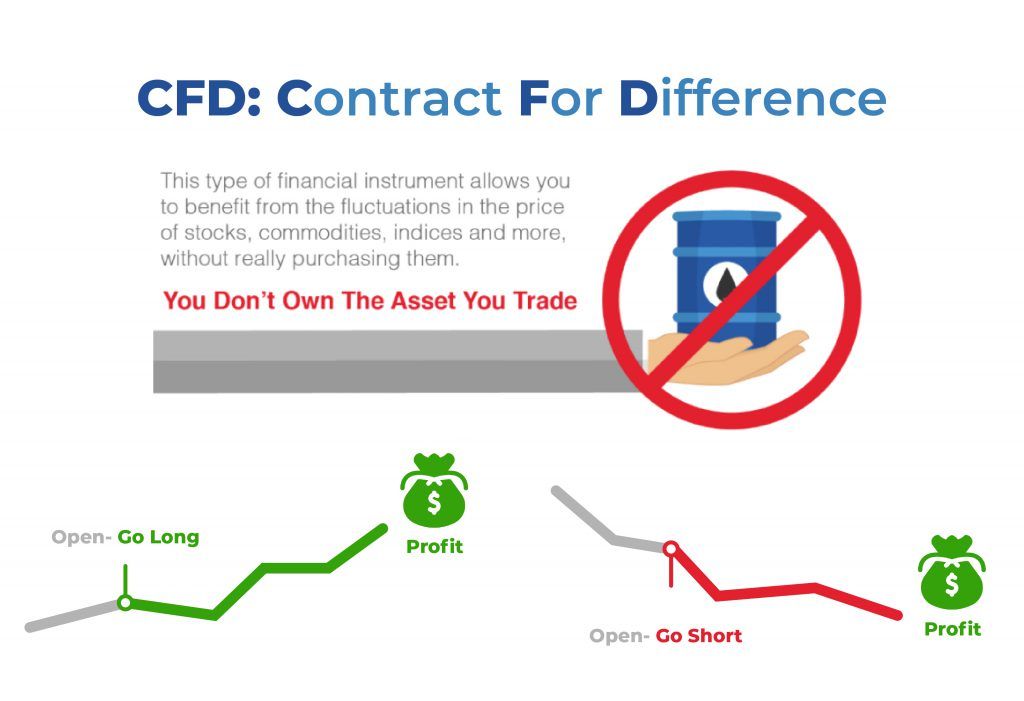
A Contract for Difference (CFD) is a financial instrument that allows you to speculate on the price fluctuations in different markets, such as indices, commodities, stocks, and Treasury bonds, or their derivatives or value estimates.
A Contract for Difference is an agreement between an investor (the buyer) and a broker (the seller) to exchange the difference in the price of a specific asset between the time the contract is opened and the time it is closed.
Now, CFDs are widely used in financial markets for their flexibility and inherent leverage, which makes them popular among short-term traders and speculators. Your task as an investor is to predict the movement of the future price of the instrument you are speculating on.
In summary, a Contract for Difference is:
- A derivative:you do not have possession of the underlying asset.
- An agreement between your broker and you.
- It is based on the variation in the price of an asset.
- It is carried out over a short period of time.
How does a CFD work?
The first thing is to choose the market you want to trade, which stock, which index, which commodity. The second is to decide whether to trade long or short.
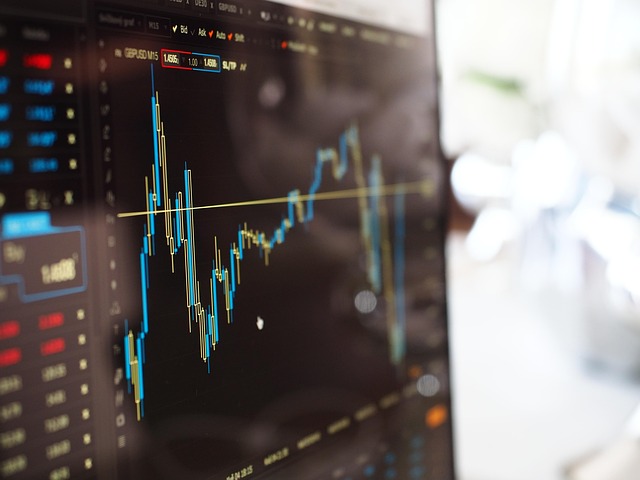
With CFDs, the same thing happens as with the rest of the markets, you have to look at the purchase price (ask) and the sale price (bid). The difference between the two prices is what is called the spread. The idea to keep in mind is that the bid price is always slightly lower than the current price of that market, and the ask price is slightly higher. Another issue to keep in mind is that when trading CFDs we are neither buying nor selling a market, but “betting” on the direction that said market will take.

What is Spread?
Sale prices will always be slightly lower than the current market price, and purchase prices will be slightly higher. The difference between the two prices is called the «spread».
- CFD prices are quoted at two prices: the purchase price and the sale price.
- The sale price is the price at which you can open a short CFD.
- The purchase price is the price at which you can open a long CFD.
Most of the time, the cost of opening a CFD position is covered in the spread, which means that the purchase and sale prices will be adjusted to reflect the cost of making the trade.
Function of the Spread
There are two types of Spread in CFDs. A Deposit Spread is required to open a position, while a Maintenance Spread may be required if your trade is close to incurring losses that the Deposit Spread and any additional funds in your account will cover.
If funds were to be lacking to pay for the loss, you may receive a call from your provider asking you to top up your account funds. If you do not add sufficient funds, the position may be closed and the losses incurred will be collected.
Role of margin and how exposure is controlled without physically owning the asset
The margin is a portion of the total value of the CFD position that the broker requires from the trader as a guarantee against potential losses. It is what makes leverage possible.
- Required Margin:The minimum amount of funds needed to open a position.
- Maintenance Margin:The minimum funds that must remain in the account to keep the position open.

Exposure control (Leverage)
The margin is the tool that allows the trader to obtain high market exposure with a relatively small capital investment. This phenomenon is known as leverage.
The leverage formula is understood as:
Leverage = (Total value of the position) / (Required Margin)
- If your broker offers leverage of 1:20, the required margin is 5% (1/20).
- With leverage of 1:100, the required margin is 1% (1/100).
Advantage: It allows amplifying gains if the market moves in your favor.
Risk: It amplifies losses if the market moves against you, potentially liquidating the total invested margin quickly.
Control without physical possession of the asset
The key to controlling exposure without owning the physical asset lies in the fact that the CFD is only a legal contract on the price, managed and controlled by the broker.
- Settlement mechanism
The broker is the intermediary that “closes” the position when you decide, or automatically if pre-established risk levels are reached.
For the trader, when you close the position, the price difference between the opening and the closing is deposited or deducted from your margin account. The actual asset is never delivered or received.
- The Margin Account Balance
Your exposure is the total value of the contract. However, the broker’s exposure and risk control are managed through your margin account:
- Gains: The gains from the contract are added to your margin balance, increasing the capital available to maintain or open new positions.
- Losses: Losses are deducted from the margin balance. If the losses are large enough to reduce your balance below the maintenance margin, the broker issues a Margin Call.
- The Margin Call
The Margin Call is the main risk control mechanism that the broker uses to protect itself.
- If the value of your position falls significantly, the broker will notify you that you must deposit more funds to restore the maintenance margin.
- If you do not deposit additional funds, or if the price continues to move against you, the broker will exercise the right to automatically close your losing positions to limit your losses and, crucially, protect itself from a debt greater than what you have in the account. In this way, ownership of the asset is irrelevant; the only thing needed is the cash flow (the margin) to cover the difference in the contract price.

Characteristics of CFDs
| No ownership of the underlying asset | You speculate on the price, you do not own the physical asset or value. For example, you do not have voting rights for having a CFD on a stock. |
| Leverage | They allow trading with a much larger amount of money than initially deposited, which increases potential gains, but also the risk of significant losses exceeding the initial capital. |
| OTC Trading (Over-The-Counter) | Contracts are made directly between the investor and the broker, they are not traded on official stock exchanges. |
| Size flexibility | You can trade with small lot sizes, such as 0.01. |
| No expiration (generally) | Positions can remain open indefinitely until the investor closes them, unlike CFDs on futures which have a fixed expiration date. |
| Low margin | A small initial margin deposit is required to open leveraged positions. |
| Counterparty risk | There is a risk that the broker may not be able to fulfill its obligations, as it is a bilateral operation and not regulated in an official market. |
Differences between CFDs
| On Stocks | Allow trading on the price of individual stocks without the need to buy them. |
| On Indices | Based on the fluctuation of stock indices such as the IBEX 35 or the S&P 500. |
| On Forex (Forex) | The price difference between currency pairs is traded. |
| On Commodities | Allow speculating with the price of assets such as gold, silver, or oil. |
| On Cryptocurrencies | You can trade with the volatility of cryptos like Bitcoin or Ethereum, without the need for a digital wallet. |
Types of spreads and commissions that may apply
| Type of Spread |
Main characteristics |
Ideal for… |
| Fixed | The spread remains constant regardless of market conditions, volatility, or liquidity (except in extreme market events). They are more predictable. | Beginners and traders who trade with short-term strategies (Scalping) during times of low liquidity. |
| Variable (or Floating) | The spread fluctuates or changes constantly. It narrows when market liquidity is high (market open, high activity) and widens when liquidity is low or volatility is high (economic announcements, market close). | Experienced traders and those who trade in markets with high liquidity (such as major Forex pairs), as under normal conditions they are usually lower than fixed ones. |
Although the spread is the dominant cost, there are other commissions and charges that must be considered when trading CFDs, especially if positions are held long-term:
- Transaction commissions.Often charged in CFD trading on stocks and ETFs.
- Overnight financing (Swap or Rollover).Applied to CFD positions (mainly in Forex and indices) that are held open overnight.
- Inactivity Commission.A monthly fee that some brokers charge if the client does not perform any operations on the platform for a prolonged period.
- Other commissions (Deposit/Withdrawal and Conversion).
Advantages of CFDs
- Access to the global market:most CFD traders offer products in most of the world’s major markets, giving the investor 24-hour access.
- CFDs offer traders the advantage of greater leverage.This can potentially amplify your gains in the markets.
- They grant access to a wide spectrum of markets, such as stocks, commodities, indices, and currencies. This fosters a diversified trading portfolio.
- They provide the opportunity to benefit from both rising and falling market movements. Thus allowing potential gains in diverse market conditions.
- Traders can speculate on price swings without the complications of owning the underlying assets.
Associated Risks
Although trading with CFDs offers several advantages, it also entails certain risks and challenges that traders must be aware of. These are the main disadvantages:
- Risks associated with leverage.Leverage can significantly increase both profits and losses. If a trade goes against the trader, losses can exceed the initial investment, which entails considerable financial risk.
- Complexity of operations.Understanding margin requirements, rollover commissions, and contract conditions requires extensive knowledge of the market and trading mechanisms.
- Costs of overnight positions.Holding CFD positions overnight incurs financing costs, which can accumulate over time and reduce overall profitability. These costs are associated with the leveraged nature of CFDs and the interest charged for holding open positions.
Example of a CFD trade
Let’s say a stock X is currently trading at $11 per share. You want to buy 1,000 CFDs because you expect the price to rise in the near future. To do this, you decide to use leverage. Your broker offers leverage of 1:100 with an initial margin requirement of 1%. This means you only have to deposit $110 into your account (1,000 units x $11 x 1%).
Let’s point out that your prediction comes true and now each stock X can be sold for $11.4. After closing your position, you make a profit of $400. Of course, you are also charged 0.1% when you open or close your positions, so you must pay $11 and $11.4 (1,000 units x price x 0.1%) from your profits. In the end, you managed to turn your initial deposit of $110 into $377.6.

Trading with stocks
- Buying a Microsoft CFD:If the price of Microsoft is at $288.50 and you believe it will rise, you can buy a Microsoft CFD at that price.
- Short selling a Coca-Cola CFD:If Coca-Cola is trading at $50.05, you can sell 50 CFDs at that price because you expect the price to fall.
Trading with commodities
- Buying an oil CFD:If you believe the price of oil will rise, buy five oil CFDs at $5,325.
- Selling a gold CFD:If the price of gold is at $0.20 and you expect it to fall, sell five gold CFDs at that price.
Trading with indices
- Selling an S&P 500 CFD:If the price of the S&P 500 is at 2,340 and you expect it to fall, you can sell five CFDs at 2,340 to open a short position.

To conclude, CFDs offer an efficient and flexible way to participate in a wide variety of financial markets with a relatively low initial capital. But, the use of leverage makes them high-risk products.
It is crucial that anyone considering trading CFDs thoroughly understands how margin works, the risks of automatic liquidation, and that you should only trade with capital you are willing to lose. The key lies in financial education and solid risk management, never in the promise of quick returns. Or as Warren Buffett indicates: “Risk comes from not knowing what you’re doing.”